How We Manufacture Ring Gears for Humanoid Robot Actuator Joints
Blog 2026-05-25
Why Ring Gears Are the Most Demanding Component in a Humanoid Robot Joint
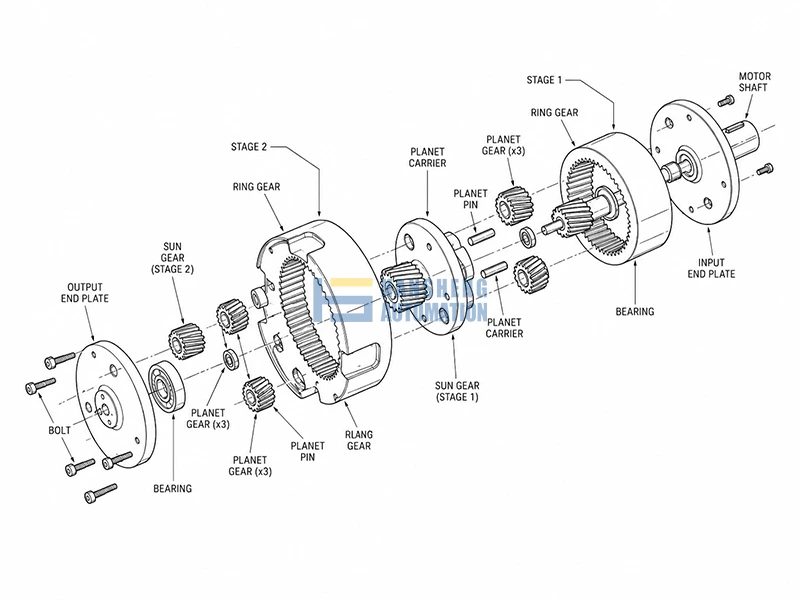
A humanoid robot typically requires 25 to 30 actuators across its joints (From Schaeffler) — shoulders, elbows, hips, knees, and ankles. Each rotary joint is driven by a compact actuator built around a 2-stage planetary gearbox, and at the heart of that gearbox sits the ring gear.
Unlike the sun or planet gears, the ring gears does not rotate. As the fixed reaction member that the planet gears push against, its internal tooth surface ultimately resolves every torque input from the motor.
This makes the ring gear the component where manufacturing precision is most critical
In a 2-stage gearbox, there are two ring gears — one for each reduction stage. Both must be held to the same precision standard. In the actuator designs we manufacture, these two ring gears are machined directly into the motor housing as a single integrated component. This eliminates assembly stack-up error; however, it also significantly raises the manufacturing challenge.
That integration is what this article is about.
Understanding the 2-Stage Planetary Gearbox Architecture
How the Two Stages Work
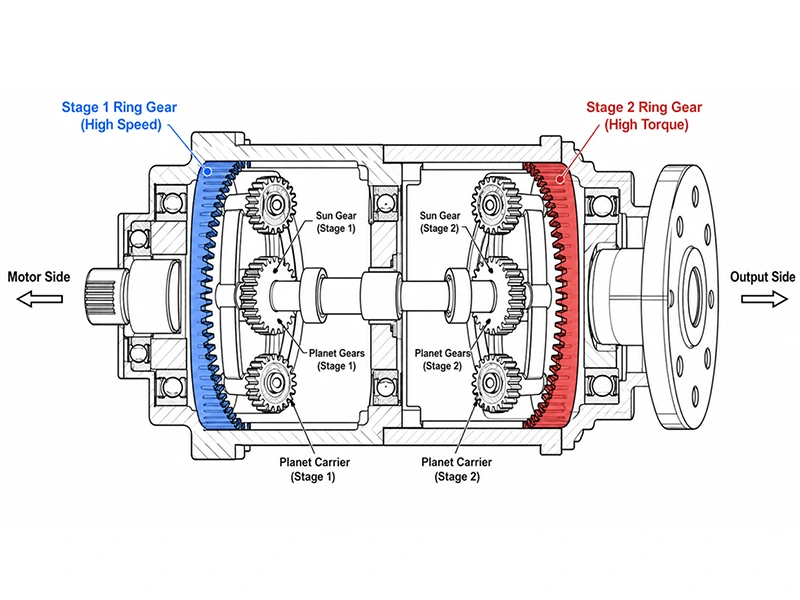
Stage 1 — First Reduction:
The motor rotor drives the Stage 1 sun gear directly. Three or more Stage 1 planet gears orbit around it, meshing with both the sun gear and the fixed Stage 1 ring gear. As the planets walk around the inside of the ring gear, the Stage 1 planet carrier collects their combined orbital motion and outputs the torque.
The Transition — An Integrated Compound Component
Instead of using a conventional shaft, Stage 1 output passes through a Stage 1 carrier / Stage 2 sun compound assembly — a single component serving two functions: one end acts as the Stage 1 planet carrier, holding the planet pins; the other end directly forms the Stage 2 sun gear profile.
Stage 2 — Second Reduction and Output:
The integrated Stage 2 Sun Gear drives a set of Stage 2 Planet Gears, which mesh against the fixed Stage 2 Ring Gear. Final torque is taken from the Stage 2 Planet Carrier, which serves as the rotating output flange of the entire actuator.
What This Means for Manufacturing
Two components define the precision ceiling of this entire gearbox:
The two ring gears are fixed reaction members that absorb tangential force from every planet gear on every engagement cycle — continuously, at load. Tooth profile error here has nowhere to hide: it translates directly into joint backlash and positioning inaccuracy at the output flange.
The compound Stage 1 Carrier / Stage 2 Sun Assembly carries two distinct functional geometries on a single part. Any coaxiality deviation between the carrier axis and the sun gear profile introduces transmission error at the stage transition — measurable as noise, efficiency loss, and increased wear over the actuator’s service life.
These are the two most dimensionally demanding component types in the gearbox, and the ones customers most frequently ask us to supply against their drawings.
The Integration Challenge — Both Ring Gears Machined Directly Into the Motor Housing
What Makes This Design Different
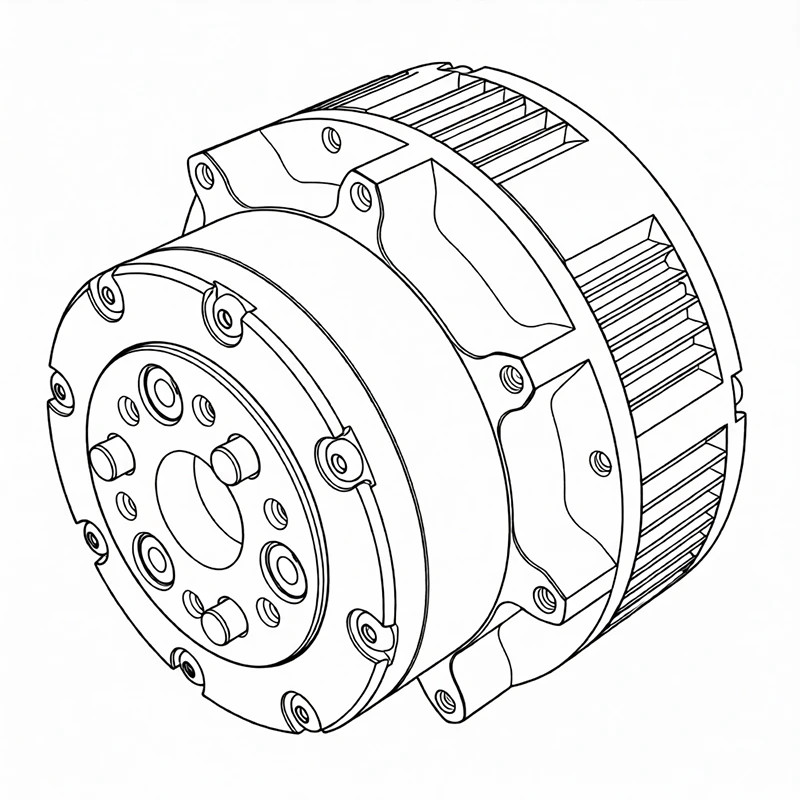
The motor housing in this actuator is not just a structural enclosure. It bonds the stator on the inside. In addition, both ring gears are machined directly into the inner bore. This design effectively transforms the housing into a structural component, a stator seat, and a dual-stage gear body.
This integration delivers real advantages:
- Zero assembly stack-up between the ring gears and the housing bore
- Higher radial stiffness — the gear teeth are part of the housing wall, not a pressed-in insert
- Reduced part count — two ring gears and a housing become one component
The Three Core Manufacturing Challenges
A Structural Part That Must Also Be a Precision Gear
Motor housings are typically designed around structural and thermal requirements — wall thickness, mounting interfaces, stator bonding surfaces. When two internal gear profiles are added to the same part, every upstream machining decision affects gear accuracy downstream. Fixturing, turning sequence, and material choice all have to be planned with the internal tooth geometry as the governing constraint, not an afterthought.
Two Internal Gear Profiles, One Workpiece
Stage 1 and Stage 2 ring gears typically carry different modules, tooth counts, and face widths. Cutting both profiles on a single workpiece within a single setup is critical. Any datum shift between sequential operations introduces a misalignment between the two stages that cannot be corrected during final grinding.
Heat Treatment Distortion on a Complex Part
After gear cutting, the housing goes through carburizing and quenching to achieve the required tooth surface hardness. A part with this geometry—thin in some sections, thick in others, with two precision bores—distorts unevenly under the thermal cycle.
Our solution
We specialize in parts that sit at the intersection of structural machining and precision gear manufacturing — the exact combination around which we build our process chain. Our gear skiving capability on the Kashifuji KPS30 suits the internal profiles on this type of integrated housing: single-clamping operation eliminates the secondary positioning errors that multi-setup shaping would introduce, and the process is stable enough to leave consistent, predictable stock for the finishing grind.
Post heat treatment, internal gear grinding brings both profiles to ISO/DIN Grade 5–6. Subsequently, CMM verification confirms the coaxiality between the two pitch axes. Finally,the part is released only after meeting these precision standards.
Ultimately, the result is a motor housing that meets both its structural and gear accuracy requirements. Because it is a single inspected component, it arrives fully ready for actuator assembly.
Our Manufacturing Process for Precision Ring Gears
A ring gear for a humanoid robot actuator does not begin with gear cutting. Crucially, the decisions made during material selection and blank preparation directly determine whether the final part can hold its tolerance after heat treatment. Below is how we approach each stage of the process.
Material Selection & Blank Preparation
The three materials we most commonly work with for robot actuator ring gears are:
- 20CrMnTi
- 17CrNiMo6
- 42CrMo
For ring gears, forged blanks are preferred over bar-cut blanks wherever wall thickness permits. Forging refines the grain structure along the gear rim, improving fatigue life at the tooth root. The blank is then rough-turned to establish the datum bores and faces, with finishing stock left on all critical surfaces to absorb heat treatment distortion in subsequent operations.
Internal Tooth Cutting: Gear Shaping vs Power Skiving
Two processes cover the majority of internal ring gear cutting in our facility.
Gear Shaping
Gear shaping uses a reciprocating cutter to generate the internal tooth profile incrementally. It is process-flexible — well suited to ring gears with tight shoulder clearances, small bore diameters, or non-standard tooth forms where tooling geometry needs to be customised. Achievable accuracy on our Nidec SE25FR and YS5120 CNC shaping machines sits at ISO/DIN Grade 7–9 before grinding.
Power Skiving
Power skiving is a continuous rotary cutting process where a helical skiving tool and the workpiece rotate on crossed axes simultaneously. Consequently, it offers significantly higher material removal rates compared to gear shaping. In addition, it provides better surface consistency on small-module internal gears, as the profile is generated in a single continuous engagement rather than through incremental strokes.
On our Kashifuji KPS30, single-clamping operation means the part is not re-fixtured between roughing and finishing passes. This directly eliminates secondary positioning errors — a meaningful advantage when two internal profiles share a common datum, as in the motor-integrated housing described in Section 3. Pre-grind accuracy from skiving reaches ISO/DIN Grade 5–7.
Which process for robot joint ring gears? For the small-module, high-precision internal gears typical of humanoid actuator ring gears, power skiving is generally the preferred route — faster cycle time, better pre-grind surface condition, and no re-fixturing risk.
Heat Treatment & Distortion Control
Carburizing & Quenching
Used with 20CrMnTi and 17CrNiMo6. Produces a hard, wear-resistant case (typically 58–62 HRC) with a tough core. Produces the most distortion of the two routes, and requires the most grinding stock allowance to recover geometry.
Nitriding
Used with 42CrMo where dimensional stability is critical. Lower surface hardness than carburizing (typically 600–700 HV), but significantly less distortion. For ring gears in smaller actuators where the post-grind stock removal window is tight, nitriding is sometimes the more controlled option.
Stock allowances on the tooth flanks and bore are set at the pre-heat-treatment turning stage based on the expected distortion pattern for that geometry. Parts that do not hold sufficient pre-grind stock after heat treatment are rejected before grinding.
Internal Gear Grinding & Final Inspection
Gear Grinding
For robot actuator ring gears, we grind internal profiles to ISO/DIN Grade 5–6 and hold tooth flank surface finish to Ra ≤ 0.4 µm. The grinding cycle removes heat-treatment distortion and establishes the final tooth geometry, which directly determines the actuator’s backlash and transmission error.
Final Inspection
To ensure every ring gear meets the stringent demands of robotic motion control, we conduct a rigorous final inspection of all critical gear parameters. Our standard metrology process includes:
- Tooth Profile
- Lead / Helix Deviation
- Pitch Deviation
- Surface Roughness
- Bore Geometry & Coaxiality
Ring Gear Specifications We Hold for Humanoid Robot Actuator Applications
The table below reflects our standard production capability for internal ring gears supplied against customer drawings.
Core Manufacturing Parameters
| Parameter | Capability |
|---|---|
| Module Range | 0.1 – 5.0 mm |
| Tip Diameter | 3 mm – 300 mm |
| Tooth Form | Spur (straight) / Helical |
| Best Achievable Precision Grade | ISO / DIN / GB Grade 5 |
| Standard Production Range | ISO / DIN / GB Grade 5 – 9 |
| Tooth Flank Surface Finish | Ra ≤ 0.4 µm (post-grind) |
| Materials Supported | 20CrMnTi, 17CrNiMo6, 42CrMo (others on request) |
| Heat Treatment | Carburizing & Quenching / Nitriding |
Precision Grade by Process
Not every ring gear requires grinding. The right process depends on the precision grade specified on the drawing and the production volume. This is how our process routes map to achievable accuracy:
| Process | Application | Achievable Grade |
|---|---|---|
| Power Skiving (Kashifuji KPS30) |
Internal & external gears, small-medium module | ISO Grade 5 – 7 |
| Gear Shaping (Nidec SE25FR / YS5120 CNC) |
Internal & external gears, flexible geometry | ISO Grade 7 – 9 |
| Gear Broaching (Fujikoshi) |
Internal gears, high-volume small parts | ISO Grade 8 – 11 |
| + Internal Gear Grinding | Post heat treatment finishing on any of the above | ISO Grade 5 |
For humanoid robot actuator ring gears, the standard route is power skiving followed by internal gear grinding, achieving ISO Grade 5 with Ra ≤ 0.4 µm on the tooth flank. Gear shaping remains available where bore geometry or shoulder clearance constrains the skiving tool approach.
A Note on Module and Diameter Limits
Our overall gear manufacturing range spans modules 0.1 – 5.0 and tip diameters up to 300 mm. In practice, humanoid robot actuator ring gears typically fall in the module 0.5 – 2.0 range and diameter 30 – 150 mm window — comfortably within our core production envelope, and the range where our skiving and grinding process chain is most optimised. That said, if a drawing falls outside these typical ranges, we can still review it. We confirm feasibility against the actual part geometry, not against a generic capability table.
Beyond Ring Gears — Full Gear Set Supply for Your Actuator
Ring gears are the components we are most frequently asked about. In practice, however, most customers who come to us with an actuator program need more than one gear type — and sourcing the full gear set from a single manufacturer has measurable advantages over splitting the bill of materials across multiple suppliers.
Here is what we manufacture across the complete 2-stage planetary gearbox gear set:
Components We Supply Against Customer Drawings
- Sun Gears
- Planet Gears
- Stage 1 Carrier / Stage 2 Sun Compound Assembly
- Planet Carriers — Stage 2 Output Carrier
Working With Us — From Drawing to Delivery
We work with robotics companies in the UK, US, and beyond on a custom-to-drawing basis. There are no standard catalogue parts on our end — every component we ship is manufactured to the customer’s own drawing and specification.
What to Include in Your Drawing Package
- Gear data block — module, number of teeth, pressure angle, helix angle if applicable, accuracy grade
- Material and heat treatment specification — or performance requirements if you prefer us to recommend
- Surface finish callout on tooth flanks
- Target first-article lead time
If your drawing is incomplete or still in development, send what you have. We regularly work with customers at the design stage and can provide input on manufacturability before the drawing is finalised. Beyond design collaboration, we also warmly welcome customers to visit our company in person / on-site.
Send Your Drawing & Request a Quote →
FAQ
We work exclusively to customer drawings. We do not maintain a standard gear catalogue. Every ring gear we ship is manufactured to the module, tooth count, accuracy grade, material, and heat treatment specified on your drawing.
Yes. We manufacture all gear components in a 2-stage planetary gearbox against customer drawings: Stage 1 and Stage 2 sun gears, planet gears in matched sets, the Stage 1 Carrier / Stage 2 Sun compound assembly, and planet carriers.
We do not enforce a fixed minimum order quantity for first article or prototype work. Customers developing humanoid robot actuators typically start with a small sample quantity for fit and function verification before committing to production volumes. To receive a quote,send your drawing and volume requirement and we will respond accordingly.