Why 2-Stage Planetary Gearbox is becoming the hot choice for Humanoid Robot Actuators
Blog 2026-05-28
A humanoid robot requires between 25 and 30 actuators distributed across its joints — shoulders (This data is from Schaeffler AG), elbows, hips, knees, and ankles. Each one must deliver precise, controllable torque under continuous dynamic loading, in a package constrained by human-scale geometry.
Harmonic drives (strain wave gears) have long been the default for precision robot joints. They offer high single-stage reduction ratios — typically 50:1 to 160:1 — with near-zero backlash, and their flat, coaxial form factor integrates well into articulated arms.
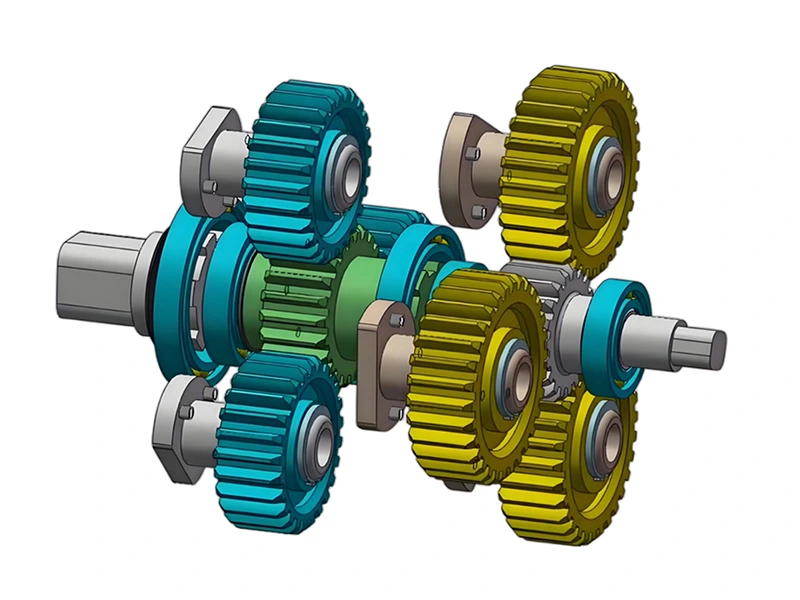
However, for humanoid robot applications, a new alternative solution is currently emerging — the 2-stage planetary gearbox, now becoming the preferred humanoid robot actuator architecture.
The specific question this article addresses
Given that planetary reduction is now a well-established solution for humanoid robot actuators, the specific question this article aims to address is: Why has the 2-stage configuration emerged?
Harmonic Drive vs Cycloidal vs Planetary Gearbox for Humanoid Robots
Three technologies compete for humanoid robot joints.
Harmonic drive
High single-stage ratios (30:1–160:1), near-zero backlash. Long the default for precision industrial arms.
Two problems for humanoid use: efficiency sits at 70–85% under continuous load — in a robot with 25+ joints, that heat accumulates fast. And high internal friction makes these joints poorly back-drivable, requiring additional sensor and control overhead to achieve compliant behavior.
Cycloidal drive
Better efficiency than harmonic (85–92%), good shock resistance from multi-point contact loading.
The bottleneck is manufacturing. The cam profile and roller geometry demand tight tolerances that are difficult to hold at production volume. As of 2025, cycloidal drives remain in testing for humanoid applications — production validation is limited.
Planetary gearbox
Efficiency typically exceeds 90% per stage. Load is shared across multiple planet gears, giving strong impact resistance.
The one constraint: a single planetary stage tops out at roughly 10:1. Humanoid joints typically require 25:1 to 100:1. That gap is exactly why the 2-stage configuration exists.
Here is how the three technologies compare across the dimensions that matter most for humanoid actuator design:
| Performance Specifications | HARMONIC DRIVE | CYCLOIDAL DRIVE | 2-STAGE PLANETARY PREFERRED |
|---|---|---|---|
| Mechanical efficiency | 70–85% Degrades under load and heat | 85–92% Design and load dependent | >90% Per stage; ~85–94% across both stages |
| Single-stage ratio range | 30:1 – 160:1 | 6:1 – 87:1 (typical) | Up to ~10:1 per stage 2-stage achieves 20:1–100:1 |
| Back-drivability | Poor High flex-spline friction | Moderate Design dependent | Good Especially at lower ratios |
| Shock & Impact resistance | Moderate Flex spline vulnerable to overload | Good Multi-point contact distributes load | Good Load shared across planet gears |
| Backlash | Near-zero | Low 1–3 arcmin typical | Moderate 2–5 arcmin; controllable with precision manufacture |
| Manufacturing scalability | Difficult Flex spline geometry limits volume production | Challenging Tight cam tolerances; limited production validation | High Involute gear geometry; automotive-scale supply chain |
| Current humanoid adoption | Tesla Optimus (rotary joints), Figure 01 upper body | Early-stage testing; limited production deployment | Unitree G1, Schaeffler platform, Agility Robotics — growing adoption across leg & arm joints |
Why 2-Stage Planetary Hits the Right Ratio for Humanoid Robot Joints
The single-stage ceiling
For most humanoid joints, 10:1 is not enough. Push beyond that and the sun gear becomes too small relative to the ring gear — tooth geometry degrades, load distribution worsens, and the design becomes mechanically inefficient.
| Joint | Typical ratio range |
|---|---|
| Hip / knee (high load) | 50:1 – 100:1 |
| Shoulder / elbow | 30:1 – 60:1 |
| Wrist / ankle | 20:1 – 40:1 |
A single planetary stage cannot cover any of these. Two stages can cover all of them.
The 2-stage solution
Two stages multiply independently. A 6:1 first stage followed by a 9:1 second stage delivers 54:1 overall — within a package only marginally longer than a single stage.
Efficiency compounds favorably too: at 95% per stage, two stages retain approximately 90% total — well above harmonic drive in continuous operation.
| Configuration | Ratio range | Est. efficiency |
|---|---|---|
| 1 stage | up to ~10:1 | ~95% |
| 2 stages | 25:1 – 100:1 | ~90% |
| 3 stages | >500:1 | ~86% |
Why not 3 stages?
Each additional stage multiplies ratio but also multiplies losses. Three stages at 95% efficiency per stage yields ~86% overall — below what most planetary QDD designs target. Axial length grows substantially, adding weight precisely where humanoid limb design penalizes it most.
The QDD context
The industry is moving toward Quasi-Direct Drive (QDD) actuators — pairing high-torque-density motors with lower gear ratios to preserve back-drivability and force transparency. In that framework, 2-stage planetary sits at the right point: enough ratio to let the motor operate efficiently, low enough to keep the joint back-drivable without torque sensor dependency.
How Integrated Motor-Housing Design Shapes 2-Stage Planetary Actuator Performance
The Integrated Motor-Housing Design — What It Demands from Manufacturers
The current trend in joint design for humanoid robots
In current humanoid actuator designs, the ring gears for both stages are integrated directly into the motor housing as a single part, rather than being separate components.
Eliminating the interface between gearbox housing and motor housing removes one source of assembly stack-up error per joint. Across 25–30 joints, that adds up to meaningful gains in positional repeatability.
The trade-off is that the housing itself becomes a precision gear component.
What this means for tolerances
Two internal gear features must be held on one part, to the same precision standard, with their axes in exact alignment. Typical requirements for humanoid actuator ring gears fall at ISO/GB grade 5–6 — a range that rules out standard gear shaping or hobbing as the finishing process.
At that grade, two process routes are viable:
- Power skiving — a continuous, high-speed cutting process well-suited to internal gears in integrated housings. It maintains the part in a single setup, preserving coaxiality between the two ring gear bores.
- Gear grinding — used as a finishing operation after heat treatment to recover geometry lost to distortion. Required when grade 5 tolerance must be held on a hardened tooth surface.
Both processes demand capable equipment and consistent process control. The difficulty is not cutting one internal gear to grade 5 — it is holding that standard on two features of the same part, in the same fixturing, across a production run.
For a deeper look at how these processes apply specifically to humanoid actuator ring gears — including heat treatment sequencing and inspection criteria — see our article on ring gear manufacturing for humanoid robot actuator joints.
Which Humanoid Robot Companies Are Adopting 2-Stage Planetary Actuators
Schaeffler
At CES 2026, Schaeffler unveiled a planetary gear actuator built specifically for humanoid robots. The specs are production-intent: 60–250 Nm torque range, 2-stage planetary configuration, integrated with motor, encoder, and controller in a single unit.
What makes this significant is not just the product — it is who is building it. Schaeffler is an automotive-grade manufacturer with decades of planetary gearbox production experience. Their move into humanoid actuators is a validation of the architecture, not an experiment with it.
In April 2026, Schaeffler extended that commitment through a technology partnership with Hexagon Robotics, with both high-precision strain wave and planetary gear actuators as part of the platform’s transmission architecture.
Unitree — planetary at volume
Unitree’s G1 humanoid uses QDD-style actuators built around low-ratio planetary gearboxes. With the G1 already in commercial sale at approximately $16,000, Unitree represents the most production-validated example of planetary-based humanoid actuation currently on the market.
Precision Manufacturing Requirements for Humanoid Robot Planetary Gear Sets
Precision grade rules out standard processes
Internal ring gears for humanoid actuators require ISO grade 5–6. Standard gear shaping — the most common process for internal gears — typically achieves grade 7–9.
Power skiving is the primary cutting route for internal gears at this precision level. It is a high-speed, continuous-engagement process that holds geometry more consistently than reciprocating shaping — but it demands purpose-built CNC skiving machines and application-specific tooling.
Heat treatment problem
Grade 5–6 cannot be held on a soft blank alone. Carburizing and quenching are required for surface hardness — and both introduce distortion. The internal tooth geometry moves during heat treatment.
Recovery requires internal gear grinding after hardening: a slow, costly finishing step that demands a machine capable of reaching inside the ring gear bore with a grinding wheel. The process chain — skiving, heat treatment, grinding, inspection — is long, and any weak link degrades the final result.
Integrated housings raise the bar further
When both ring gears are machined into a single motor housing, the tolerance requirement applies to two internal features on one part. Coaxiality between the two ring gear bores must be held across the full process chain — rough machining, heat treatment, finish grinding — without re-referencing the part between operations.
This is where fixturing discipline and process sequencing separate capable suppliers from the rest.
The volume consistency problem
A single humanoid robot typically requires 25 to 50 planetary gearsets (or more, depending on whether a 2 stage gearbox is counted as one or two sets). For practical sourcing, this translates to hundreds to thousands of ring gears when production scales to even a few hundred robots.
Achieving grade 5–6 on a sample is a process capability question. Holding it across a production run is a quality system question.
What this means for sourcing
This means your supplier must be able to meet all four of the following requirements: master the internal gear power skiving process, possess post-hardening internal gear grinding capabilities, excel in precision machining of integrated housings, and ensure product consistency throughout mass production.
With our years of experience in custom gear projects and a broad range of gear manufacturing processes, we have successfully delivered planetary gears, planetary joint actuator components, and other related parts for humanoid robot customers in the UK, Canada, the US, and other regions. If you are evaluating suppliers for planetary gear sets, our Gear Drawing Package and RFQ Guide details the exact information we need from you in order to provide an accurate quotation.
How to Source a 2-Stage Planetary Gear Set: Specs, Drawings, and Supplier Criteria
Drawing package requirements
An accurate quote requires complete geometry and process intent. For each gear component, your drawing should specify:
| Parameter | What to include |
|---|---|
| Module | Nominal value + tolerance |
| Tooth count | Sun, planet, ring — all three |
| Helix angle | 0° for spur, specify if helical |
| Precision grade | ISO / DIN / GB — state the standard |
| Material | Grade and condition (e.g. 20CrMnTi, annealed) |
| Heat treatment | Process type, target surface hardness, case depth |
| Inspection requirements | Grade confirmation method, CMM or gear measuring machine |
Supplier capability checklist
Before engaging a supplier, confirm they can demonstrate:
- Power skiving or gear grinding for internal gears at ISO grade 5–6
- Post-hardening finishing capability — not just soft cutting
- CMM or dedicated gear measuring equipment for grade verification
- Experience with integrated housing parts, not just standalone gear blanks
- Sample + production volume experience, not prototype-only
For a complete guide on structuring your drawing package and what information accelerates quoting, see our Gear Drawing Package & RFQ Guide.
If you have drawings, send them. If you are still in design, we can work from specifications. Contact us to start the conversation.
FAQ
It varies by joint. Load-bearing joints — hip, knee — typically require 50:1 to 100:1. Upper body joints such as shoulders and elbows generally fall in the 30:1 to 60:1 range. Wrist and ankle joints typically require 20:1 to 40:1.
Planetary gearboxes offer higher mechanical efficiency (>90% vs 70–80% for harmonic drives under continuous load), better back-drivability, and stronger impact resistance. They also draw on a mature manufacturing supply chain capable of supporting high-volume production — a practical advantage as humanoid robot output scales.
ISO grade 5–6 is the standard requirement for ring gears in humanoid actuator applications. Achieving this requires power skiving or gear grinding as the finishing process, combined with post-hardening grinding to recover geometry lost during heat treatment.
Not for most joints. A single planetary stage tops out at approximately 10:1, which falls well below the 20:1–100:1 range required by humanoid joints. A 2-stage configuration is the minimum practical solution.
A humanoid robot typically uses 25 to 30 actuators. Not all use planetary gearboxes. For those with 2‑stage planetary, a common compact design uses one integrated ring gear per gearbox (containing both internal gear sections), so the robot would need approximately 25 to 30 ring gears. If separate ring gears are used for each stage, the number would be 50 to 60.