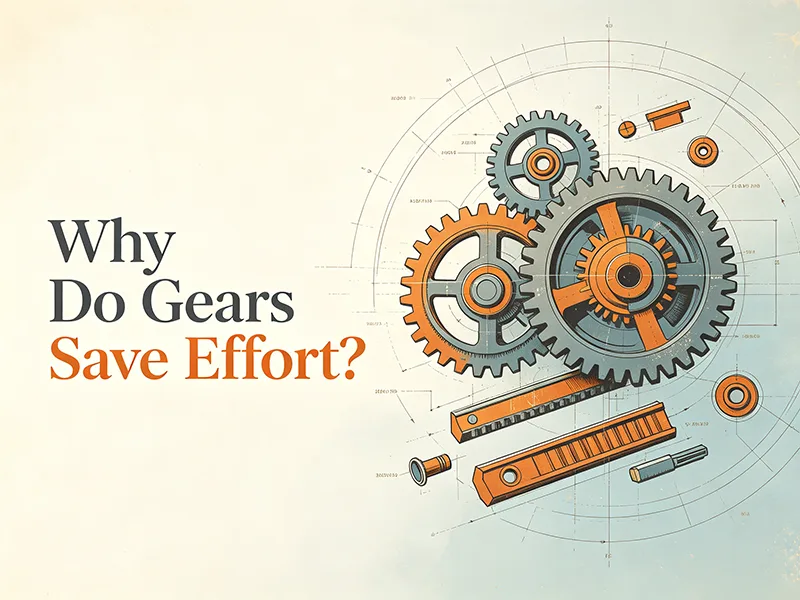
Why Do Gears Save Effort?
Blog 2026-09-10
Gears can reduce the effort required to move a load by increasing torque through a gear ratio. When a small gear drives a larger gear, the output torque increases while the rotational speed decreases. This is the mechanical advantage provided by the difference in pitch radius and tooth count.
Strictly speaking, gears do not always “save effort.” Their effect depends on which gear is driving and which gear is driven. A gear train can increase torque and reduce speed, or increase speed while reducing torque.
How Do Gears Increase Torque?
A gear can be understood partly through the same principle as a wheel and axle or a lever. When two gears mesh, the force acting at the contact point is transmitted between the gears. The pitch circle radius determines the effective lever arm.
Let the pitch radii of the driving gear and driven gear be and .
For the driving gear:
For the driven gear:
When a small gear drives a larger gear, the driven gear has a larger pitch radius. Therefore, the output torque is greater than the input torque.
For gears with the same module, the pitch radius is also proportional to the number of teeth. The gear ratio can therefore be written as:
where is the number of teeth and is rotational speed.
The ideal torque relationship is:
and the output speed is:
This is why a small driving gear can produce greater torque at the output. The gear system provides a mechanical advantage by trading rotational speed for torque.
The important point is that the gear teeth themselves are not the “lever arm.” The relevant dimension is the pitch circle radius. The tooth count provides another convenient way to express the same relationship.
A Simple Gear Ratio Example
Consider a 20-tooth gear driving a 60-tooth gear.
The gear ratio is:
Suppose the input torque is 10 N·m and the input speed is 300 rpm.
The ideal output torque is:
The output speed is:
The result is a threefold increase in torque and a threefold reduction in rotational speed.
This is the basic reason gears are useful when a machine needs more turning force at the output.
Does Saving Effort Mean Getting More Energy?
No. Increasing torque does not create additional energy.
Under ideal conditions, mechanical power remains constant:
where is power and is angular speed.
Because the output torque increases, the output speed decreases by the corresponding ratio. In other words, the system provides more turning force at the cost of rotational speed.
Real gear systems also have losses caused by factors such as friction and gear meshing. Therefore, actual output torque is lower than the ideal value:
where represents transmission efficiency.
So the more accurate description is “torque multiplication,” not free energy.
Do Gears Always Save Effort?
No. The result depends on the direction of transmission.
When a small gear drives a larger gear:
- Torque increases.
- Rotational speed decreases.
- The system provides a mechanical advantage for high-load applications.
When a large gear drives a small gear:
- Torque decreases.
- Rotational speed increases.
- The system is used for speed increase rather than torque multiplication.
This is why it is not accurate to say that gears always make a machine “easier.” Their function is to change the relationship between torque and speed.
What Determines Whether a Gear Can Handle the Increased Torque?
Increasing the gear ratio does not automatically mean that a gear can safely carry a heavier load. The gear must still withstand the resulting tooth forces and mechanical stresses.
Factors such as gear material, heat treatment, tooth surface hardness, gear size, tooth geometry, manufacturing accuracy, and installation conditions affect the load-carrying capability of the gear.
Common gear materials include quenched and tempered steels, hardened steels, carburized and hardened steels, nitrided steels, cast steels, cast irons, ductile irons, and engineering plastics. Material selection depends on the required load, speed, wear resistance, noise level, and operating conditions.
Summary
Gears can “save effort” because a gear ratio can increase output torque. When a small gear drives a larger gear, the difference in pitch radius or tooth count creates a mechanical advantage:
at ideal conditions, while the output speed decreases according to:
The principle is therefore simple: more torque means less speed, and less torque means more speed. Gears do not create energy. They redistribute torque and rotational speed to match the requirements of a mechanical system.