Gear Broaching vs Power Skiving for Internal Gears: Cost & Precision Analysis
Blog 2026-05-20
Both gear broaching and power skiving are internal gear machining processes, and the choice between them depends on the specific application. Below, Hansheng provides an in-depth comparison of gear broaching vs power skiving from the perspectives of working principles, machining accuracy, cost, and more.
How Each Process Works
Gear Broaching — One Stroke, One Done
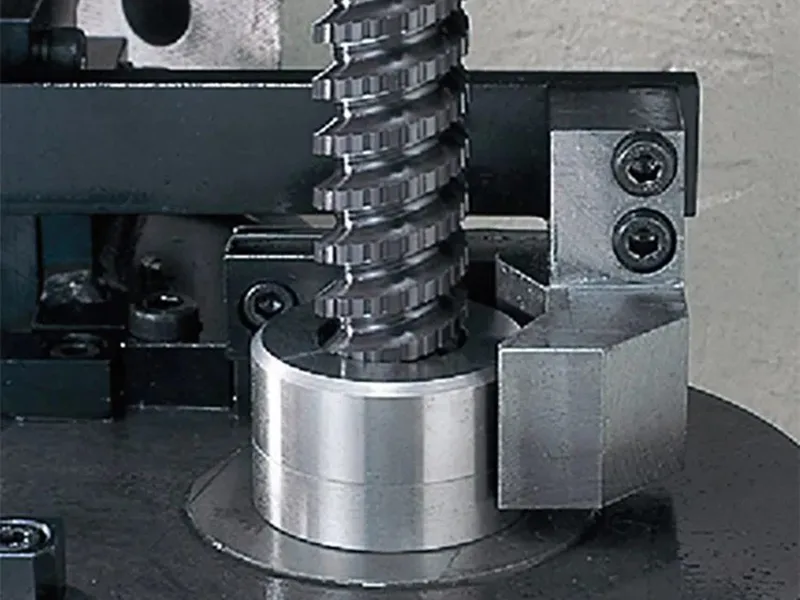
Broaching removes material through a single linear pass. The broach tool carries dozens of progressively larger cutting teeth; each tooth removes a thin layer of material until the final teeth produce the finished tooth profile.
For internal gears, the broach is pulled or pushed through a pre-bored hole. The entire tooth form — all teeth simultaneously — is generated in one stroke lasting only a few seconds.
- No re-clamping, no multiple passes
- Extremely consistent output across a production run
- Zero flexibility: one broach cuts exactly one gear profile
The process asks nothing complex of the machine. What it demands instead is an expensive, geometry-specific tool — and the volume to justify it.
Power Skiving — Continuous Cutting, One Setup
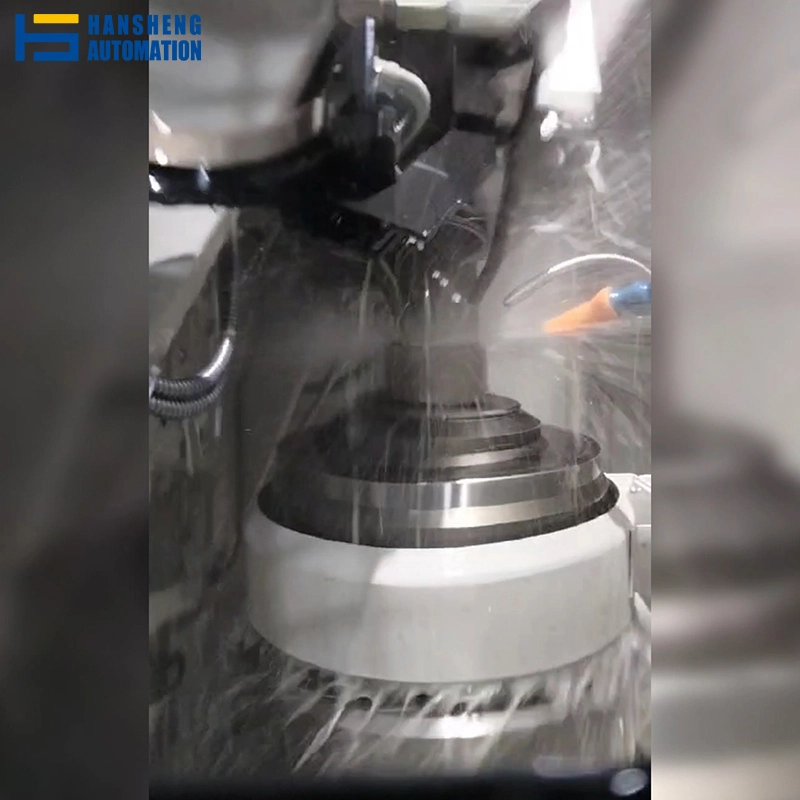
Power skiving is a continuous rotary cutting process. The skiving cutter and the workpiece spindle rotate in a synchronized, high-speed relationship, with their axes set at a deliberate cross angle. As the cutter feeds axially through the bore, the oblique engagement geometry generates the tooth form progressively along the full face width.
Advantage:
- Roughing and finishing completed in a single clamping
- Both internal and external gears machinable on the same setup
- Gear profiles and helix angles adjustable through CNC parameters, not tooling changes
Power skiving is sometimes described as “hobbing turned inside out.” The analogy holds: it brings the efficiency of a continuous generating process into the bore — something hobbing itself cannot physically do.
Key Differences: Motion, Axes, Changeover
| Gear Broaching | Power Skiving | |
|---|---|---|
| Cutting motion | Linear, single stroke | Continuous rotary |
| Tool engagement | All teeth simultaneously | Progressive, helical |
| Axes required | 1 (linear) | 5 (synchronized multi-axis) |
| Machine requirement | Dedicated broaching press | Rigid CNC with synchronized spindles |
| Profile change | New broach required | CNC parameter change |
| Helix/shoulder clearance | Limited | Capable |
Cost Comparison: Broaching vs Power Skiving
Tooling Cost: One-Time Broach vs Flexible Skiving Cutter
Broaching tooling is the single largest upfront cost in the process. A broach is a precision, geometry-specific tool manufactured to match one gear profile exactly. Change the module, tooth count, or helix angle — and you need a new broach.
Typical cost for high-precision, full-profile gear or spline broaches: $5,000 – $50,000 depending on size and complexity. Custom broach often come with time costs.
Power skiving cutters are not cheap either — but they serve a fundamentally different economic role. A single skiving cutter can produce multiple gear variants by adjusting CNC parameters. And unlike a broach, worn skiving cutters can be resharpened and recoated multiple times before replacement.
| Gear Broaching | Power Skiving | |
|---|---|---|
| Tooling cost | $5,000 – $50,000 per profile | Lower per variant |
| Tool reusability | Resharpenable, but profile-locked | Resharpenable + multi-profile capable |
| Tooling risk on design change | High — sunk cost | Low |
Machine Investment: Dedicated Press vs CNC Platform
A dedicated broaching press is a single-purpose machine. It does one thing well, at very high speed, for very long runs. The infrastructure requirement is real: special foundations, high clamping forces, and limited integration with other operations.
Power skiving runs on a rigid, high-precision CNC platform with synchronized spindles. The capital cost is higher per machine — but the machine is not single-purpose. Turning, milling, drilling, and gear cutting can all occur in one clamping on a capable multitasking center, eliminating re-fixturing error and reducing floor space requirements.
For manufacturers already running modern CNC turning centers, adding power skiving capability is often an incremental investment rather than a separate machine purchase.
Per-Part Cost vs Production Volume
This is where the selection decision usually gets made.
Broaching’s economics are front-loaded: high tooling cost, near-zero marginal cost per part once the broach exists. At high volumes, that fixed cost amortizes into a very low per-part figure — and a cycle time measured in seconds per piece makes it hard to beat.
Power skiving carries lower tooling entry cost but longer cycle times per part. Its per-part cost curve is flatter — favorable at low-to-medium volumes, less dominant as quantities climb into the tens of thousands.
As a professional gear manufacturer, here is our recommendation:
| Annual Volume | Recommended Process | Primary Reason |
|---|---|---|
| < 1,000 pcs | Power Skiving | Tooling cost not justifiable for broaching |
| 1,000 – 10,000 pcs | Power Skiving | Flexibility, lower total investment |
| 10,000 – 50,000 pcs | Evaluate both | Depends on part complexity and precision spec |
| > 50,000 pcs (stable design) | Broaching | Per-part cost advantage is decisive |
Note:These thresholds are indicative. Actual breakeven shifts with part size, material, and precision requirements.
Hidden Costs Worth Accounting For
Two cost categories are frequently underweighted:
Changeover and setup cost. A broach change requires physical tool swap, alignment, and trial cuts — often several hours of non-productive time. On a power skiving cell, switching between gear variants is largely a program call. For mixed-model production or frequent design iterations, this difference compounds quickly.
Design change exposure. In development programs — EV drivetrains, robotics joints, new industrial gearboxes — gear geometry often changes between prototype and production. A broach procured to a preliminary drawing becomes scrap the moment the tooth count or module changes. A skiving cutter does not.
Broaching vs Skiving Precision Limits
Before comparing processes, a quick orientation on gear accuracy standards — because the grading systems run in opposite directions and confusion here leads to real specification errors.
| Standard | Grade Range | Higher Precision = |
|---|---|---|
| GB / DIN / ISO | 1 – 12 | Lower number |
| AGMA | 3 – 15 | Higher number |
GB (China National Standard) aligns directly with DIN/ISO in both scale and tolerance values. A GB Grade 6 gear and a DIN Grade 6 gear represent equivalent accuracy.
Throughout this section, all grades follow the GB/DIN/ISO convention: lower number = tighter tolerance.
Achievable GB Grades: Broaching (8–11) vs Skiving (5–7)
| Process | Typical GB Grade Range | Notes |
|---|---|---|
| Power Skiving | 5 – 7 | Upper range requires high-rigidity machine + premium tooling |
| Gear Hobbing | 6 – 7 | External gears only; Grade 5 requires subsequent grinding |
| Gear Shaping | 7 – 9 | Reciprocating stroke limits surface consistency |
| Gear Broaching | 8 – 11 | Excellent consistency within its range; not suited for high-precision specs |
Two things stand out immediately.
First, broaching’s precision ceiling sits at approximately GB / ISO Grade 8 under normal production conditions. For many automotive and industrial applications — seat adjusters, accessory drives, standardized gearbox ring gears — this is entirely sufficient. For robot joints, EV planetary stages, or any application where noise, efficiency, and fatigue life are primary concerns, it is not.
Second, power skiving’s grade range of 5–7 — with the nuance that, based on our production experience on machines like the Kashifuji KPS30, some internal gears directly achieve Grade 5 while most reach Grade 6 — is genuinely competitive with grinding at the upper end.
What Drives Precision in Each Process
Broaching precision is tool-driven.
Accuracy is fixed by the broach’s geometry at manufacture — consistent but capped. No machine adjustment can improve it.
Skiving precision is system-driven.
It depends on machine rigidity, spindle synchronization, cutter quality, workholding, and thermal stability. More variables introduce risk, but also tunability. A capable operator can push skiving to GB Grade 5; broaching on the same part cannot reach that level regardless of tuning.
Surface Finish and Tooth Profile Quality
Precision grade covers dimensional accuracy — profile deviation, pitch error, lead variation. Surface finish is a related but separate consideration.
Broaching produces a clean, consistent surface in a single pass. Ra values in the range of 0.8 – 1.6 μm are typical without secondary operations. The tool marks run axially (along the face width), which is favorable for contact fatigue but less so for noise-sensitive applications.
Power skiving produces a characteristic diagonal feed mark pattern — a consequence of the helical engagement geometry. This pattern is not a defect. It has been shown to reduce meshing noise compared to axial and periodic feed marks, because the surface micro-texture interrupts resonant contact excitation. For EV and robotics applications where NVH targets are stringent, this is a practical advantage.
Broaching vs Power Skiving: 4 – Phase Quick Guide
Precision
Grade 5–6 → Skiving only. Grade 7+ → either.
Volume & stability
<5k pcs/yr or design changes → Skiving.
30k pcs/yr & frozen design → Broaching.
Geometry
Skiving if: blind bore, shoulder blocking exit, diameter >200 mm, or high helix.
Supplier check
Broaching: verify broach condition & press.
Skiving: rigid CNC + sync control; ask for Grade 6+ proof; Grade 5 needs finish grinding.
| If your requirement is… | Recommended path |
|---|---|
| High volume (>30K), GB/ISO 8–9, stable design | Broaching |
| Low-to-mid volume, any precision, evolving design | Power skiving |
| GB/ISO Grade 5–6, any volume | Power skiving + grinding |
| Helical internal, shoulder clearance limited | Power skiving |
| Mixed model, frequent changeover | Power skiving |
| GB/ISO Grade 7, volume >30K, frozen design | Evaluate supplier capability for both |
Internal Gear Supplier with Multi-Process Capability (Broaching, Skiving, Grinding)
Manufacturers with genuine multi-process capability offer something more useful than a single technology: process optionality. When volumes grow, designs stabilize, or precision requirements tighten, the manufacturing path can evolve without changing suppliers.
At Hansheng Automation, internal gear production runs across all four major processes — skiving, hobbing, shaping, and broaching — on dedicated equipment for each. The skiving line runs on the Kashifuji KPS30, a platform purpose-built for the synchronization demands of power skiving, capable of reaching GB Grade 5 on qualifying geometries. For high-volume internal gear requirements where broaching is the rational choice, the Fuji broaching machine handles production runs with the consistency that single-stroke processes are known for.
For parts sitting in the GB Grade 7 specification zone — where the process decision is genuinely close — having both capabilities under one roof means the process can be selected on engineering merit rather than equipment availability.
The facility also maintains in-house grinding capability, which matters specifically for Grade 5 requirements: skiving produces the pre-grind geometry with sufficient stock, and grinding brings the final part to tolerance.
- Gear module range: 0.1 – 5.0
- Tip diameter: 3 – 300mm
- Achievable grade: GB/DIN/ISO 5
Conclusion
If the precision requirement is GB Grade 8 or coarser and annual volume exceeds 30,000 pieces on a frozen design, broaching is likely the right process. In every other scenario, power skiving deserves serious consideration — and for Grade 5 – 6 requirements, it is the only soft-cutting option available.
Working With Hansheng Automation
Hansheng Automation has been producing custom precision gears for over a decade, with manufacturing capability spanning spur gears, helical gears, bevel gears, gear racks, and gear shafts across all four major internal gear cutting processes.
For internal gear programs specifically, the facility runs:
- Power skiving on the Kashifuji KPS30 — GB Grade 5 – 7, module 0.1 – 5.0, tip diameter up to 300mm
- Gear broaching on the Fuji broaching machine — GB Grade 8 – 11, suited for high-volume small internal ring gears
- Gear shaping on the Nidec SE25FR and YS5120 CNC — GB Grade 7 – 9, internal and external, including shouldered and stepped configurations
- In-house grinding for Grade 5 final finishing
If you have an internal gear program under evaluation — whether the process is already defined or still open — the most useful next step is a geometry and volume review. Process recommendation, tooling feasibility, and indicative pricing can typically be provided within a few business days.
FAQ
No. Broaching remains more cost-effective for: volumes >30k/yr, frozen design, GB Grade 8 or coarser. Choose by geometry, volume, and precision — not blanket replacement.
Grade 7 is the overlap zone. Both can work. Decision is supplier-dependent: ask for documented Grade 7 output on similar geometry and part ‑ to ‑ part measurement capability — not just first ‑ article.
Broaching: soft steel only (pre‑heat‑treat). Not for hardened material.
Skiving: works soft and hard (hard skiving 58–62 HRC). Same process family can cover pre‑and post‑heat‑treat, maintaining datum consistency.
Provide: part drawing/3D model (module, teeth, pressure angle, helix, grade), material & heat‑treat requirement, annual volume & batch size, delivery expectations, and any NVH/application needs. If process is open, state it — a multi ‑ process supplier can then recommend the best method.