Types of Planetary Gearsets: Simple, Simpson, Ravigneaux, and Compound Designs
Blog 2026-09-26
There is no single planetary gear architecture used for every application. Planetary gearsets can be arranged in different ways depending on the number of sun gears, planet gears, carriers, and the way different gearsets are connected.
Common structures include simple planetary gearsets, compound planetary gearsets, and specific layouts such as Simpson and Ravigneaux gearsets.
It is useful to distinguish between these categories. Simple and compound planetary gearsets describe structural arrangements, while Simpson and Ravigneaux refer to specific compound layouts. They are therefore not four completely parallel categories.
Simple planetary gearset
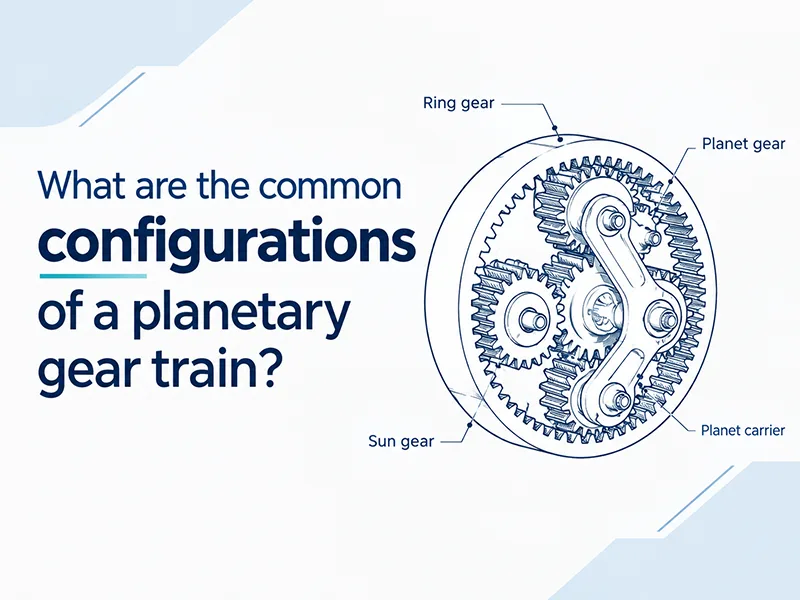
A simple planetary gearset usually consists of one sun gear, one ring gear, one planet carrier, and one or more planet gears.
The sun gear is located at the center, while the planet gears are mounted on the carrier and mesh with both the sun gear and the ring gear. When the carrier moves, the planet gears rotate around their own axes while also orbiting around the sun gear axis.
One advantage of this arrangement is its relatively simple structure. Different transmission relationships can be obtained by changing which member is fixed, which member is used as the input, and which member serves as the output.
For example, when the ring gear is fixed, the sun gear is the input, and the carrier is the output, the reduction ratio can be expressed as:
where is the number of teeth on the ring gear and is the number of teeth on the sun gear.
The simple planetary gearset is also the basic structure used to understand more complex planetary gear architectures.
Compound or double planetary gearset
When two or more planetary gearsets are connected through shared gears, carriers, or other components, a compound planetary gear arrangement can be formed.
Compared with a simple planetary gearset, the purpose of a compound arrangement is not simply to add more gears. The connection between multiple gearsets allows the system to create more transmission states and a wider range of speed ratios.
There is no single internal layout that represents every double planetary gearset. Different arrangements use different shared components and gear connections. Simpson and Ravigneaux gearsets are two representative examples of compound planetary structures.
Simpson planetary gearset
The Simpson planetary gearset is a well known compound arrangement that combines two planetary gearsets. Its characteristic feature is that the two planetary gearsets share a common sun gear.
The two gearsets can also be connected through carriers, ring gears, or other members. By using different combinations of clutches and brakes, the transmission can establish multiple forward gears and reverse operation.
The Simpson gearset was widely used in traditional multi-speed automatic transmissions, including earlier three-speed and four-speed automatic transmissions. Its design uses shared components to reduce structural duplication while maintaining the compact layout associated with planetary gearing.
Ravigneaux gearset
The Ravigneaux gearset is another common compound planetary architecture.
A typical Ravigneaux arrangement contains two sun gears, two sets of planet gears, one common planet carrier, and one ring gear. The two planet gear sets have different meshing relationships. The inner planet gears mesh with one sun gear, while the outer planet gears mesh with the other sun gear and the ring gear. The two sets of planet gears are also interconnected.
This arrangement allows several gear elements to be integrated into a relatively compact structure. Ravigneaux gearsets have been widely used in automatic transmission designs and are also an important example for understanding the kinematics of compound planetary systems.
The main advantage of the Ravigneaux arrangement is not simply that it uses more gears. Its value comes from the way multiple gear elements are combined to provide different transmission states within a compact package.
How are these planetary gearsets different?
| Gearset type | Main components | Typical characteristic | Common applications |
|---|---|---|---|
| Simple planetary | One sun gear, planet gears, one carrier, one ring gear | Simple structure and clear kinematic relationships | Reduction mechanisms, automatic transmissions |
| Compound or double planetary | Two or more planetary arrangements | Shared or connected components provide more transmission states | Multi-speed transmissions, compact transmission systems |
| Simpson | Two planetary gearsets | The two gearsets share a common sun gear | Traditional automatic transmissions |
| Ravigneaux | Two sun gears, two planet gear sets, one carrier, one ring gear | Different planet gear sets work together in one integrated arrangement | Automatic transmissions |
These categories describe common structures rather than every possible planetary transmission design. An actual automatic transmission may contain several planetary gearsets connected through clutches, brakes, and fixed members to create a complete transmission system.
Modern transmissions may also use multiple planetary gearsets or nested arrangements when a wider ratio range is required within a limited installation space.
Why does planetary gear architecture matter in engineering design?
The choice of planetary architecture is closely related to the requirements of the transmission.
Installation space
Packaging space is often an important consideration. Planetary gearsets can use a coaxial arrangement, which makes them suitable for equipment with strict radial or axial space constraints.
Compound and nested planetary layouts can improve the use of available space by integrating multiple gearsets into the same transmission package.
Transmission ratio and number of gears
A simple planetary gearset can provide different speed ratios by changing the input, output, and fixed members.
When multiple planetary gearsets are combined, the transmission can establish more operating states and a wider range of ratios. This is particularly useful in multi-speed transmission systems.
Manufacturing and control complexity
More complex planetary structures require closer coordination between gears, carriers, bearings, clutches, and brakes.
As the number of components and operating states increases, manufacturing accuracy, assembly conditions, lubrication, and control strategy become more important. The most suitable architecture therefore depends on the required torque, speed, ratio range, available space, efficiency, manufacturing cost, and service requirements.
A more complex planetary structure is not automatically a better choice. The architecture should match the operating requirements of the transmission.
FAQ
There is no single fixed number. Planetary gearsets can be classified according to their structural arrangement, and different engineering references may use different classification methods. Simple planetary, compound planetary, Simpson, and Ravigneaux are common structures discussed in mechanical transmission and automotive applications.
A Simpson gearset is a compound planetary arrangement made from two planetary gearsets with a common sun gear.
A typical Ravigneaux gearset uses two sun gears, two sets of planet gears, one common planet carrier, and one ring gear. The two planet gear sets have different meshing relationships, allowing multiple transmission states within a compact arrangement.
The choice depends on the required torque, speed, ratio range, installation space, efficiency, control strategy, manufacturing cost, and service requirements. A simple planetary gearset may be sufficient for a single reduction stage, while a compound arrangement may be considered when multiple ratios or tighter packaging are required.