Which is better: a worm gear or a helical gear?
Blog 2026-04-16
Worm gear and helical gear are widely used in industrial power transmission. Both can reduce speed and multiply torque. But they achieve this in fundamentally different ways. Those differences have real consequences for efficiency, noise, load capacity, and total cost of ownership.
This message will break down exactly how worm gears and helical gears compare, when each one is the right call, and what trade-offs you need to understand before specifying either for your next project.
Quick Comparison: Worm Gear vs. Helical Gear
| Feature / Metric | Worm Gear | Helical Gear |
|---|---|---|
| Shaft Orientation | 90° Non-intersecting (Right Angle) | Parallel or Crossed Shafts |
| Transmission Efficiency | 50% – 90% (Decreases as ratio increases) | 95% – 98% (High efficiency) |
| Single-Stage Gear Ratio | High (5:1 up to 100:1) | Low to Medium (1:1 up to 10:1) |
| Self-Locking Capability | Yes (Static self-locking when lead angle < 5°) | No (Can be back-driven) |
| Motion & Noise | Smooth, sliding contact, low noise | Smooth, rolling-sliding contact, quiet |
| Heat Generation | Higher (Due to sliding friction) | Minimal (Rolling contact dominant) |
| Typical Material Pair | Hardened Steel Worm + Bronze Gear Wheel | Carburized & Hardened Alloy Steels |
| Best Used For | Compact right-angle drives, hoists, indexing | High-speed, heavy-duty, continuous gearboxes |
What Is a Worm Gear
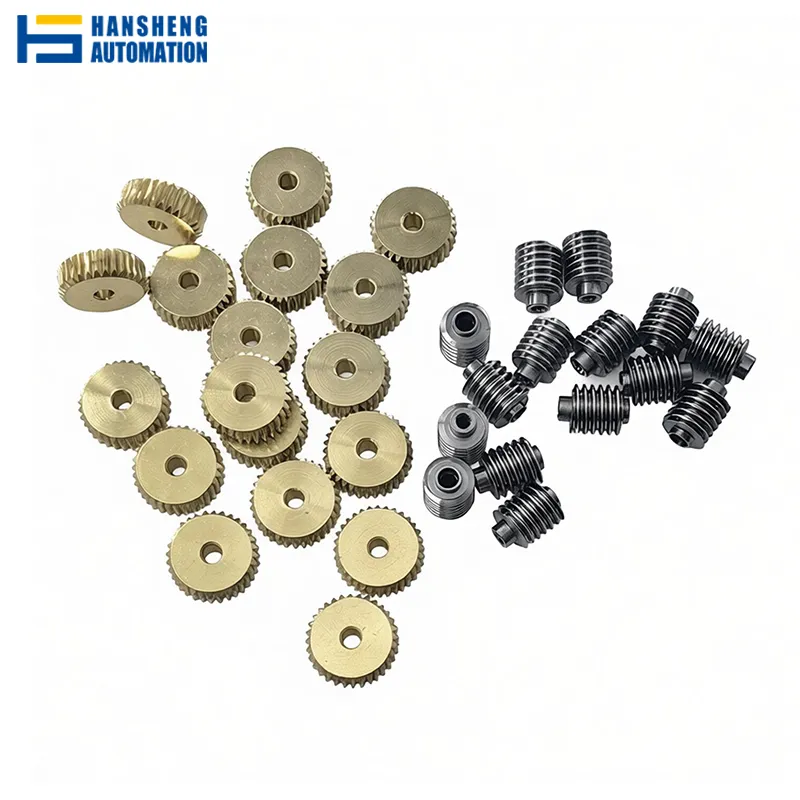
A worm gear consists of two main components, a worm and a worm wheel. The two shafts sit at a 90° angle to each other.
The worm rotates and drives the wheel, but critically the wheel cannot back-drive the worm under most conditions.
Key Features:
- High Reduction Ratio in Single Stage: Capable of 5:1 up to 100:1 speed reduction in a compact space.
- 90° Right-Angle Drive: Ideal for tight machinery footprints where perpendicular shaft orientation is required.
- Self-Locking Potential: Prevents back-driving under static conditions (lead angle < 5°).
- Trade-off (Disadvantage): Lower transmission efficiency (50%-90%) and higher heat generation due to sliding friction.
What Is a Helical Gear
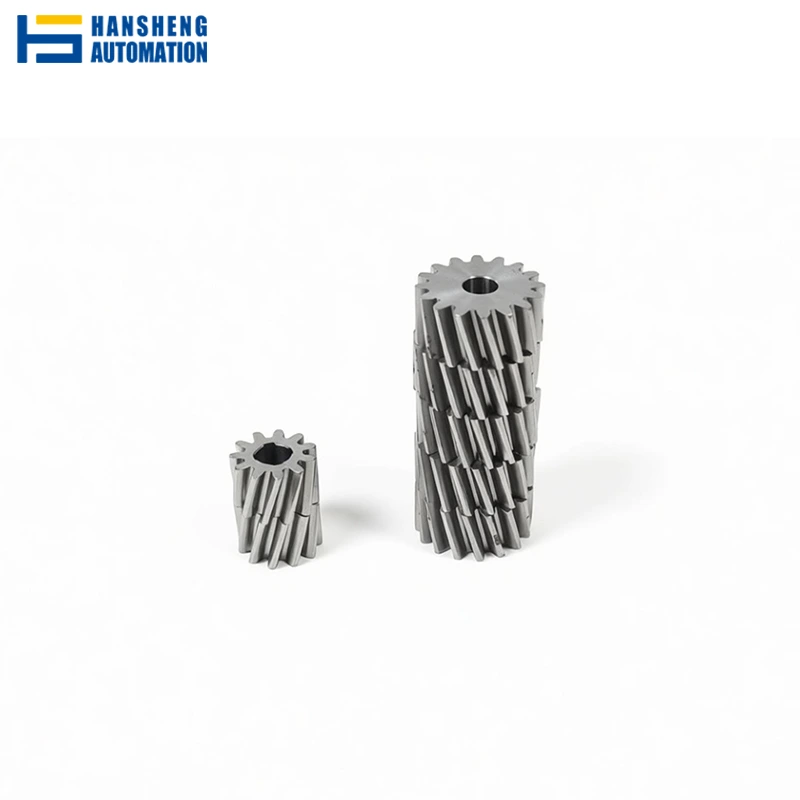
A helical gear is a cylindrical gear with teeth cut at an angle to the rotational axis.
Unlike worm gears, helical gears are primarily used on parallel shafts, and their angled teeth engage gradually.
Key Features:
- High Efficiency (>95%): Rolling contact minimizes power loss and heat buildup.
- Smooth & Quiet Operation: Angled teeth engage gradually, reducing vibration and noise.
- High Speed & Torque Capacity: Carburized steel teeth handle heavy industrial continuous loads.
- Trade-off (Disadvantage): Generates axial thrust forces that require thrust bearings; cannot provide right-angle drive without crossed-shaft designs.
In-Depth Engineering Differences: Worm Gear vs Helical Gear
Efficiency, Sliding Friction, and Thermal Management
The fundamental difference between worm gears and helical gears lies in how power is transferred at the tooth mesh.
- Helical Gears: operate primarily through rolling contact with minor sliding. This results in superior mechanical efficiency (typically 95–98% per stage) and minimal heat buildup.
- Worm Gears: transfer power almost entirely through sliding contact along the worm thread. This sliding action causes considerable energy loss through friction. At high reduction ratios (e.g., 60:1), efficiency can drop below 60%.
Note: Because this friction converts lost power into heat, high-ratio worm gearboxes require thermal dissipation considerations, such as cooling fins or forced oil lubrication, during continuous operation.
The Self-Locking: Static vs. Dynamic Safety
Worm gears are famous for their self-locking capability, meaning the worm gear wheel cannot drive the worm shaft in reverse.
- Dynamic Back-Driving Danger: Under vibration, shock loads, or high operating temperatures, dynamic self-locking can fail.
- Safety Warning: Never rely solely on a worm gear’s self-locking feature for overhead lifting, hoists, or critical personnel safety equipment. Always integrate a secondary mechanical brake system.
Material Selection and Wear Considerations
Because worm gear sets experience continuous sliding, pairing identical hard metals (like steel on steel) leads to immediate galling and premature failure.
Worm Gear Sets pair a hardened alloy steel worm shaft (e.g., 20CrMnTi) with a softer bronze gear wheel (e.g., ZCuSn10Pb1 phosphor bronze). The bronze serves as a sacrificial wear element to protect the assembly.
Helical Gears utilize carburized, hardened alloy steel for both pinion and gear wheel, enabling much higher surface durability, higher load capacity, and longer service life.
Which Should You Choose
There’s no single correct answer, but there is a clear decision framework. Use this as your starting point.
Choose Worm Gear When:
- Right-angle shaft arrangement
- Self-locking / load holding
- Very high single-stage reduction (>10:1)
- Compact footprint with high torque at low speed
Choose Helical Gear When:
- Maximum energy efficiency
- High speed and high load, continuous duty
- Low noise and vibration
- Long service life with minimal maintenance
- Parallel shaft configuration
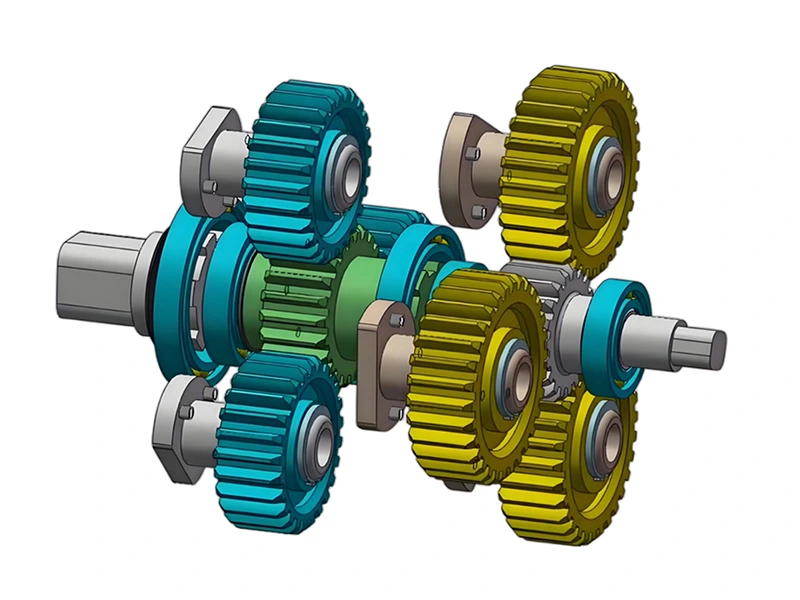
In practice, many industrial systems use both gear types at different stages of the same transmission system. The input stage employs a worm gear drive to achieve compact, high-ratio speed reduction, while the output stage incorporates a helical gear drive to ensure efficient and smooth power transmission.
Worm Gears and Helical Gears Built for Industrial Demands
At Hansheng Automation, we manufacture precision worm gears and helical gears engineered to meet the real demands of industrial environments. From standard catalog configurations to fully custom gear sets designed around your exact specifications, our engineering team delivers components you can depend on.
Send Inquiry NowFAQ
Yes, but only by using crossed-axis helical gears or a bevel-helical gearbox. However, if you need a high single-stage reduction ratio (e.g., >30:1) in a compact right-angle space, a worm gear set remains the most cost-effective and space-saving choice.
Worm gears transfer power primarily through sliding friction along the worm thread, converting a significant portion of energy into heat. Helical gears, on the other hand, transfer power mostly through rolling contact, which minimizes friction and achieves higher efficiency (95%–98%).
Both gear types are much quieter than straight spur gears. Worm gears are generally the quietest because of their continuous, smooth sliding engagement, making them ideal for noise-sensitive environments like stage lifts and medical equipment.
For high-ratio applications (>30:1), a single-stage worm gearbox is usually cheaper and smaller than a multi-stage helical gearbox. However, because the bronze gear wheel in a worm set wears down faster, total lifecycle maintenance costs should be factored in for continuous heavy-duty use.
Worm gears most commonly fail due to bronze wheel tooth wear and thermal breakdown of lubrication caused by sliding friction. Helical gears typically fail due to tooth surface fatigue (pitting) or tooth bending breakage under extreme impact loads.