What Is a Planetary Gear?
Blog 2026-09-15
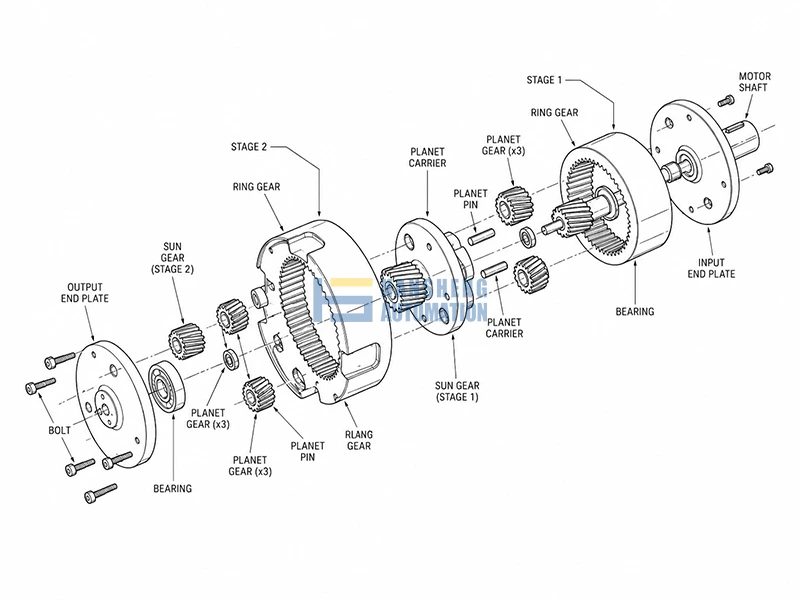
A planetary gear is a gear system in which one or more gears revolve around a central gear. Unlike a conventional fixed-axis gear train, a planet gear rotates on its own axis while also revolving around the axis of the central gear.
The planet gear has two types of motion. It rotates around its own axis and revolves around the central axis with the planet carrier. This arrangement gives the system its name and allows it to transmit high torque in a compact, coaxial package.
Basic Components of a Planetary Gear
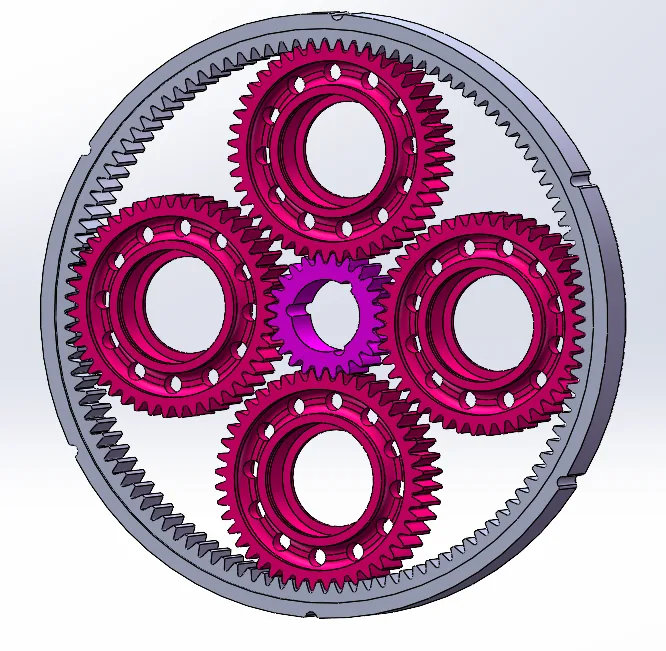
A typical single planetary gear set has four main components.
Sun gear: The sun gear sits at the center and normally has external teeth. Depending on the transmission arrangement, it can serve as the input or output member.
Planet gears: Planet gears mesh with both the sun gear and the internal teeth of the ring gear. Planet pins on the carrier support the gears and allow them to rotate around their own axes. Many designs use three to five planet gears. Designers may also choose helical teeth to improve meshing smoothness and reduce noise.
Planet carrier: The carrier supports the planet gear pins and rotates around the central axis. It provides structural support while also carrying a significant part of the transmitted torque.
Ring gear: The ring gear surrounds the planet gears and has internal teeth. Designers often fix it to the housing, but the ring gear can also serve as the input or output member in other transmission arrangements.
The assembly can also include planet pins, bearings, spacers, housing components, lubrication passages, and seals. These parts all influence load capacity, service life, efficiency, and operating accuracy.
How Planetary Gears Are Classified
Engineers commonly classify planetary gear systems by planet arrangement, spatial arrangement, gear mesh configuration, and the member held stationary.
By Planet Arrangement
A single planetary gear set uses one group of planet gears. Its relatively simple construction makes it common in industrial gearboxes and other mechanical transmission systems.
A double planetary arrangement uses two groups of planet gears. This configuration provides additional transmission relationships and allows designers to create more complex speed and torque combinations.
By Spatial Arrangement
A planar planetary gear system keeps the gear axes parallel. This arrangement simplifies manufacturing and assembly and accounts for many common planetary gearbox designs.
A spatial planetary gear system uses gear pairs whose axes are not all parallel. Differential mechanisms provide a typical example of this arrangement.
By Gear Mesh Configuration
Common planetary gear configurations include NGW, NW, WW, and NN types.
An NGW arrangement uses a sun gear, planet gears, and an internal ring gear. The sun gear meshes externally with the planet gears, while the planet gears mesh internally with the ring gear. This configuration appears frequently in industrial reduction systems.
By the Fixed Member
The three main members are the sun gear, ring gear, and planet carrier. Designers can hold any one of them stationary while using the other two as the input and output members.
Changing the stationary member changes the speed ratio and rotation direction. This gives the same basic gear set several possible transmission arrangements.
Planetary Gear Speed and Transmission Ratio
For a simple planetary gear train, the speed relationship between the sun gear, ring gear, and carrier is:
where:
- = number of teeth on the sun gear
- = number of teeth on the ring gear
- = sun gear speed
- = ring gear speed
- = carrier speed
The transmission ratio changes according to which member remains stationary.
Ring Gear Fixed
Suppose the ring gear remains stationary:
With the sun gear as input and the carrier as output:
The sun gear and carrier rotate in the same direction. This arrangement provides speed reduction and sees widespread use in industrial gearboxes.
Planet Carrier Fixed
Now hold the carrier stationary:
With the sun gear as input and the ring gear as output:
The negative sign shows that the sun gear and ring gear rotate in opposite directions.
Sun Gear Fixed
Finally, hold the sun gear stationary:
With the ring gear as input and the carrier as output:
The ring gear and carrier rotate in the same direction. This arrangement suits applications that require a relatively small speed ratio together with high output torque.
When engineers allow all three main members to rotate, the planetary gear system has two degrees of freedom. That operating arrangement allows the system to work as a differential. An automotive differential provides a familiar example: the left and right wheels can rotate at different speeds while the system continues to transmit torque.
Advantages of Planetary Gears
Compact Coaxial Design
A planetary gear system can place the input and output on the same axis. This coaxial layout saves installation space and works well in compact machinery.
High Torque Density
Several planet gears can share the transmitted load. The gear set therefore spreads the load across multiple gear meshes instead of relying on a single gear pair.
This arrangement allows a planetary gearbox to transmit high torque without requiring the same overall volume as some conventional gear configurations.
Smooth Operation
Multiple gear meshes remain active within the planetary system, which helps maintain smooth torque transmission. Good manufacturing accuracy, suitable tooth geometry, proper lubrication, and correct assembly can further reduce noise and vibration.
Flexible Transmission Ratios
Designers can change the transmission relationship by adjusting tooth counts or selecting a different stationary member. Engineers can also combine several planetary stages to achieve higher reduction ratios.
Modular Construction
Designers can combine different sun gears, planet gears, carriers, and ring gears to create various gearbox sizes and transmission ratios. This makes planetary systems suitable for both standardized product lines and application-specific designs.
Limitations of Planetary Gears
The compact arrangement also increases manufacturing and assembly requirements.
The sun gear, planet gears, and ring gear must maintain the correct tooth relationship, concentricity, and assembly clearances. Small dimensional or positional errors can interfere with proper meshing and load distribution.
Uneven Load Distribution
Designers need to pay close attention to load sharing between the planet gears. Manufacturing tolerances, assembly errors, carrier deformation, or housing deformation can cause one planet gear to carry more load than the others.
Uneven loading raises local tooth stress and can accelerate pitting, wear, or tooth breakage.
To improve load sharing, designers may use a floating sun gear, floating ring gear, flexible planet pins, or other load-sharing structures.
Lubrication and Heat Dissipation
The gears sit close together, and high-speed operation can generate significant heat. Insufficient lubrication can increase friction and accelerate wear, scuffing, and pitting.
Some low-speed, high-load applications can use oil bath lubrication. High-speed systems often require oil injection or forced lubrication to maintain the lubricant film and control operating temperature.
Noise and Vibration
Planetary gear systems can generate vibration from gear mesh frequencies, planet pass frequencies, bearing effects, and interactions with housing natural frequencies.
Engineers can control these effects through gear accuracy, tooth modifications, dynamic balancing, carrier stiffness, and housing rigidity.
Common Failure Modes
Planetary gears can experience many of the same failure modes found in other gear systems.
Typical problems include:
- Tooth surface pitting
- Tooth root fatigue and fracture
- Scuffing and adhesive wear
- Gear tooth wear
- Bearing damage
- Planet carrier deformation
Overload, impact, poor lubrication, manufacturing errors, and uneven load sharing can all accelerate gear failure.
Because several gears and supporting components work together, engineers should examine the complete planetary assembly when diagnosing a failure rather than focusing only on the damaged tooth.
Key Design Considerations
Planetary gear design starts with the tooth-count relationship between the sun gear, planet gears, and ring gear. The geometry must keep the components concentric and allow all gear meshes to work correctly.
When a design uses multiple planet gears, engineers also need to check their spacing and mounting positions. The gears must fit into the assembly without interference and maintain suitable load sharing.
Load sharing becomes especially important in high-torque planetary gearboxes. Floating components, flexible planet pins, and suitable carrier designs can help compensate for manufacturing and assembly errors.
Material selection and heat treatment directly affect gear durability. Manufacturers often make sun gears and planet gears from carburizing steels, then use carburizing, hardening, and grinding processes to improve surface hardness and fatigue resistance. Depending on size and operating conditions, a ring gear may use carburizing, nitriding, or quench-and-temper treatment.
The planet carrier needs enough strength and rigidity to handle the transmitted load. Engineers may choose forged steel or high-strength cast iron depending on the application.
Bearing selection also affects planetary gearbox performance. Designers may choose needle bearings, cylindrical roller bearings, or plain bearings for the planet gears. High-speed and heavily loaded applications require careful consideration of bearing clearance, lubrication, cooling, and service life.
Lubrication design should cover oil selection, oil level, spray direction, return passages, and heat dissipation. The lubrication method must match the gear speed, load, and operating temperature.
Applications of Planetary Gears
Planetary gears serve in reducers, speed increasers, and variable-speed transmission systems across many industries.
Planetary gear sets serve automatic transmissions, dual-clutch and hybrid transmission systems, power-split mechanisms, and differentials in the automotive industry.
New energy and wind power equipment relies on planetary gears in wind turbine gearboxes, yaw and pitch drives, and electric vehicle reduction systems.
Aerospace applications include helicopter main gearboxes and engine accessory drives, while marine propulsion and deck machinery also use planetary gearing.
In construction, mining, lifting, and metallurgical equipment, planetary gear systems handle wheel-end drives, hoisting, slewing, and travel mechanisms.
In robotics, machine tools, and automation equipment, planetary gearboxes support servo drives, precision transmission systems, and other applications that require high torque density and compact dimensions. Small planetary gearboxes also appear in power tools.
Summary
A planetary gear is a compact transmission system in which planet gears rotate around their own axes while also revolving around the central axis.
Its main advantages come from the coaxial layout, multiple load-sharing gear meshes, flexible transmission ratios, and high torque density. These characteristics make planetary gears useful where installation space is limited but the transmission still needs to handle substantial torque.
At the same time, the design places higher demands on tooth geometry, concentricity, load sharing, material, heat treatment, lubrication, bearings, and assembly accuracy. The performance of a planetary gearbox depends on the complete transmission system, not only on the individual gears.