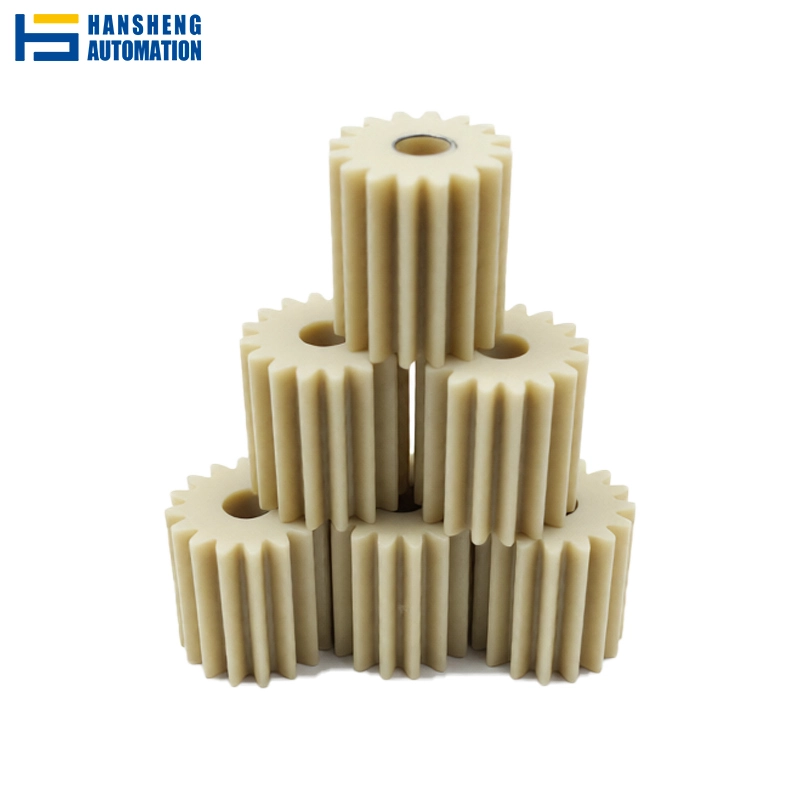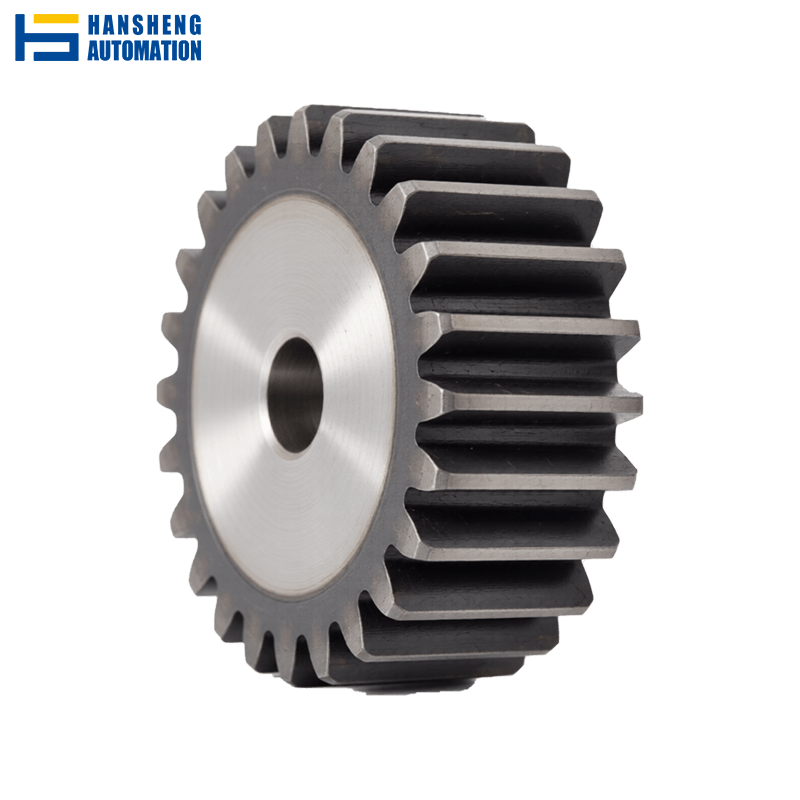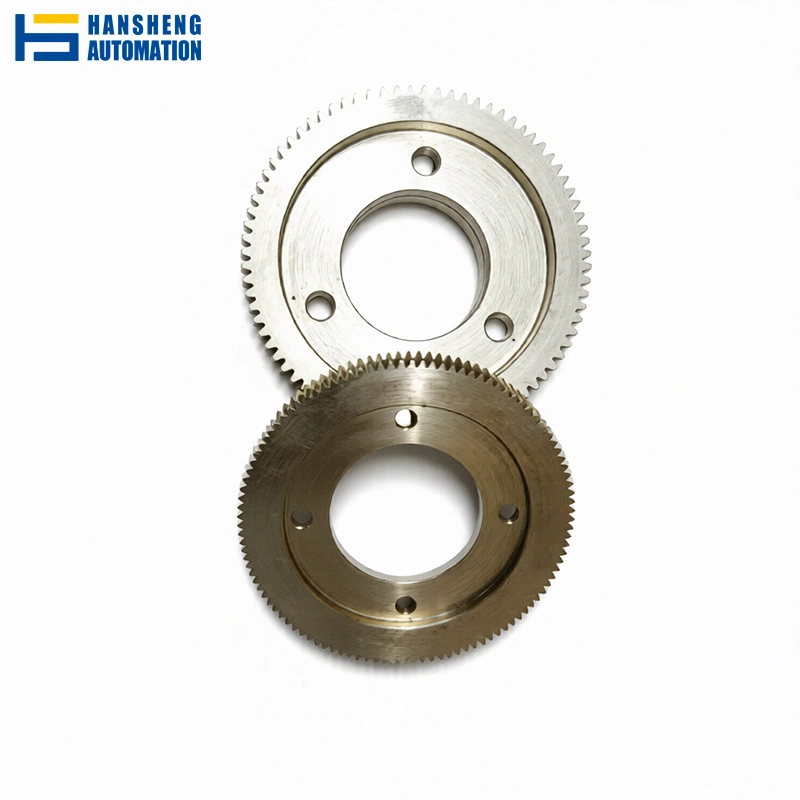
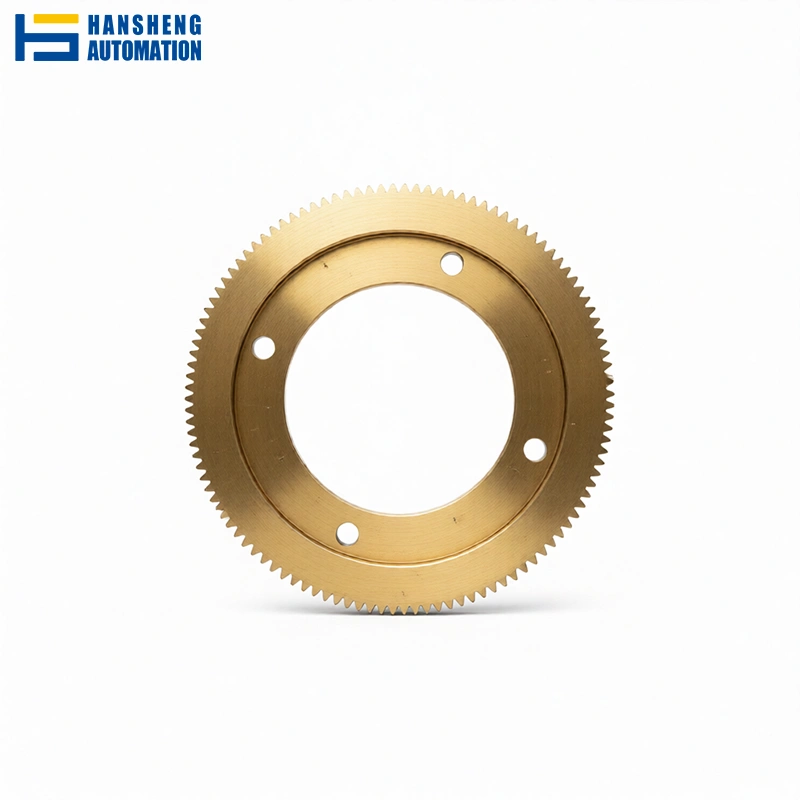
Brass Spur Gears
Brand: Hansheng
Accuracy: ISO/DIN/GB Grade 7–11
Module: 0.4 – 5.0
Outer diameter: 3 – 300 mm
Introduction

Hansheng Automation’s brass spur gears are manufactured to ISO/GB accuracy grades 5 through 9, covering modules from 0.1 to 5.0 and outer diameters from 3 mm to 300 mm. Each gear is produced using process-matched equipment — Gear Hobbing for high-efficiency external gears, Gear Shaping for internal and external profiles, and precision grinding where Grade 5 surface finish is required.
Brass combines natural corrosion resistance with a low friction coefficient, making it the preferred material for instrumentation, automation drives, and precision mechanisms that demand smooth, quiet operation without heavy lubrication. Whether you need stock dimensions or a fully custom specification, our engineering team works from your drawing or requirements.
Hansheng Automation’s brass spur gears are supplied to equipment manufacturers across India and Southeast Asia.
Why choose brass spur gears?
Corrosion-resistant by nature
Brass forms a stable oxide layer that resists moisture, mild acids, and ambient humidity without any additional surface treatment. For instrumentation, medical devices, and indoor automation where chemical exposure is moderate, this eliminates the coating and re-coating cycles associated with carbon steel gears.
Quiet, low-friction operation
The natural lubricity of brass reduces friction at the tooth contact interface, resulting in quieter meshing and lower heat generation at moderate loads and speeds. This makes brass spur gears a common choice for office equipment, laboratory instruments, and consumer devices where noise is a design constraint.
Precision to ISO / GB Grade 5
Our brass spur gears are available from Grade 7 (hobbed) through Grade 5 (ground finish, custom order). Accuracy grade is selected based on your application requirements — not applied uniformly across all parts. Module range 0.1 to 5.0, outer diameter 3 mm to 300 mm.
Custom-ready, four processes in-house
Gear Hobbing for high-efficiency external gears, Gear Shaping for internal and external profiles, Gear Skiving for complex internal geometries, and Gear Broaching for high-volume small internal gears — all produced in-house at Hansheng Automation. Prototype to production without outsourcing.
Specifications & Manufacturing Capabilities
All brass spur gears are manufactured in-house at Hansheng Automation. The table below reflects confirmed production capabilities — custom specifications are quoted on request.
| Parameter | Range |
|---|---|
| Material | Brass (C36000 or equivalent free-cutting brass) |
| Gear type | External spur gear, internal spur gear |
| Module (metric) | 0.1 – 5.0 |
| Tip diameter (OD) | 3 mm – 300 mm |
| Accuracy grade | ISO / GB Grade 5 – 9 |
| Pressure angle | 20° (standard); 14.5° available on request |
| Tooth form | Involute |
| Bore type | Plain bore, finished bore; keyway on request |
Note on accuracy grade: Grade 5 requires a grinding operation and applies to custom orders only. Standard hobbed and shaped gears are typically supplied to Grade 6–7. Please specify your required grade when enquiring.
Process-specific parameters
| Process | Applicable gear type | Max module | Max OD (external) | Accuracy grade |
|---|---|---|---|---|
| Gear Hobbing | External spur gear | 3.0 | 200 mm | ISO/GB6-7 |
| Gear Shaping | External & internal spur gear | 4.0 | 200 mm (external) | ISO/GB7-9 |
| Gear Skiving | Internal & external spur gear | — | — | ISO/GB5-7 |
| Gear Broaching | Internal spur gear (small) | — | — | ISO/GB8-11 |
| Gear Grinding | External spur gear | — | — | ISO/GB5 |
Need a specification not listed above?
Our standard capability covers the ranges shown above, but many applications fall outside these parameters — smaller modules, non-standard bore configurations, specific surface finish requirements, or paired gear sets. Submit your drawing or describe your requirements and we will confirm feasibility and lead time.
Why Brass? Material Comparison
| Feature | Brass | Carbon Steel | Stainless Steel | Engineering Plastic |
|---|---|---|---|---|
| Corrosion resistance | Excellent | Poor (requires coating) | Very good | Good |
| Machinability | Excellent | Moderate | Difficult | Easy |
| Noise level | Low | Moderate | Moderate–High | Very low |
| Load capacity | Moderate | High | High | Low |
| Lubrication demand | Low | High | Moderate | Very low |
| Typical accuracy (achievable) |
GB 5–7 | GB 4–6 | GB 5–7 | GB 8–10 |
| Best fit | Instruments, automation, light-to-medium drives | Heavy industrial, high torque | Wet, chemical, food-grade | Noise-critical, ultra-light load |
Facing complex conditions? If your application involves competing demands (e.g., high humidity and high load), contact our engineering team for a material evaluation before you finalize your specification.
Common Applications
Brass spur gears are specified wherever corrosion resistance, quiet operation, and dimensional stability matter more than maximum load capacity. The following industries represent the most common use cases we supply.
- Instrumentation & Measurement Equipment
- Industrial Automation & Light Drive Systems
- Medical & Pharmaceutical Equipment
- Clocks, Watches & Precision Timekeeping
- Consumer Electronics & Office Equipment
- Antique Restoration & Heritage Machinery
How to Choose the Right Brass Spur Gear
The most common sourcing mistakes happen before anyone looks at a catalog. This guide covers the four decisions that determine whether a gear will work in your application — and the errors we see most often when they go wrong.
1 Start with module, not tooth count
Module is the single most important parameter. It governs tooth size, load capacity, and which gears can mesh together.
As a practical starting point:
| Load condition | Suggested module range |
|---|---|
| Very light (instruments, clocks) | 0.1 – 0.5 |
| Light (office equipment, small actuators) | 0.5 – 1.5 |
| Moderate (general automation, drives) | 1.5 – 3.0 |
| Medium (heavier drive stages) | 3.0 – 5.0 |
These ranges are indicative for brass spur gears at moderate speeds. If your application involves impact loads, continuous high-speed running, or elevated temperatures, material selection should be revisited before module is finalised — brass has a yield strength of roughly 100–350 MPa depending on alloy and temper.
2 Metric Module and Imperial Diametral Pitch are Non-Interchangeable
This is our most common compatibility error.
- Metric Module (m) = Pitch Diameter (mm) / Tooth Count
- Imperial Diametral Pitch (DP) = Tooth Count / Pitch Diameter (inches)
Because their tooth geometries differ, metric and imperial gears cannot mesh—even if they look similar. For example, while m≈25.4/DP(making 32 DP roughly equivalent to Module 0.8), they will not mesh in practice.
Note: Please verify your existing system’s standard (Metric or Imperial) before ordering replacement gears.
3 Mating Gears Must Share the Same Module and Pressure Angle
For gears to mesh correctly, two parameters must match exactly:
- Module / DP
- Pressure Angle (e.g., a 20° gear will not mesh with a 14.5° gear, even if they share the same module).
While center distance, tooth count ratio, and face width can vary between a gear pair, the module and pressure angle cannot.
Note: When ordering a replacement gear, always verify both parameters via drawings or measurements. Ordering by tooth count alone is not sufficient.
4 Common selection errors to avoid
- Over-specifying Accuracy Grades
- Ignoring Face-Width-to-Module Ratio
- Assuming Brass Resists All Corrosion
- Over-sizing the Bore
If you have a drawing, send it directly — our engineering team will check compatibility and flag any specification issues before production begins. If you are still at the design stage, we are happy to advise on module and gear ratio selection for your specific load and speed requirements.
FAQ
In light-load, low-speed applications — such as clock mechanisms, laboratory instruments, and small actuators — brass gears commonly run dry without meaningful wear. For moderate loads or continuous duty, a light grease or oil is recommended to extend service life. Brass does not demand the lubrication schedules that carbon steel gears require, but it is not exempt from lubrication entirely.
Torque capacity depends on module, tooth count, face width, operating speed, and the specific brass alloy. As a material reference point, free-cutting brass (C36000) has a tensile strength of approximately 340–470 MPa and yield strength of roughly 100–310 MPa depending on temper.
Yes, and this is a common configuration. Pairing a brass gear with a harder steel pinion is standard practice in applications where the gear is the intended wear element — it is easier and cheaper to replace the brass gear than the steel shaft or pinion. Ensure both gears share the same module and pressure angle.
The minimum order quantity is 5 pieces per specification.
Most orders are fulfilled within 2 to 3 weeks from order confirmation. Confirmed lead time is specified in the contract at the time of order placement, as actual production scheduling depends on order quantity, specification complexity, and current capacity. If your project has a fixed delivery deadline, please indicate this when enquiring so we can assess feasibility before you commit.