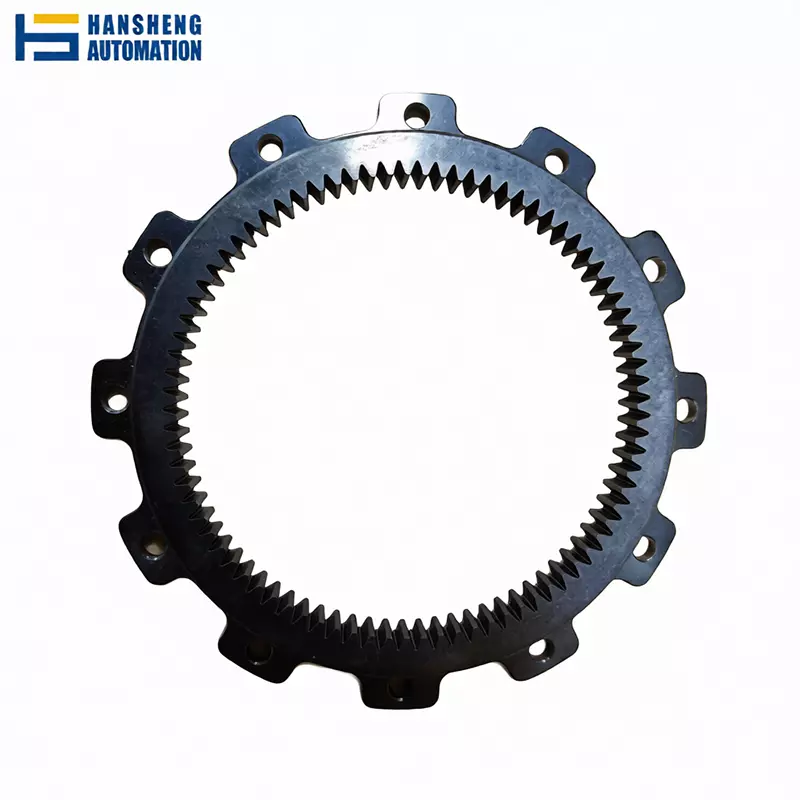
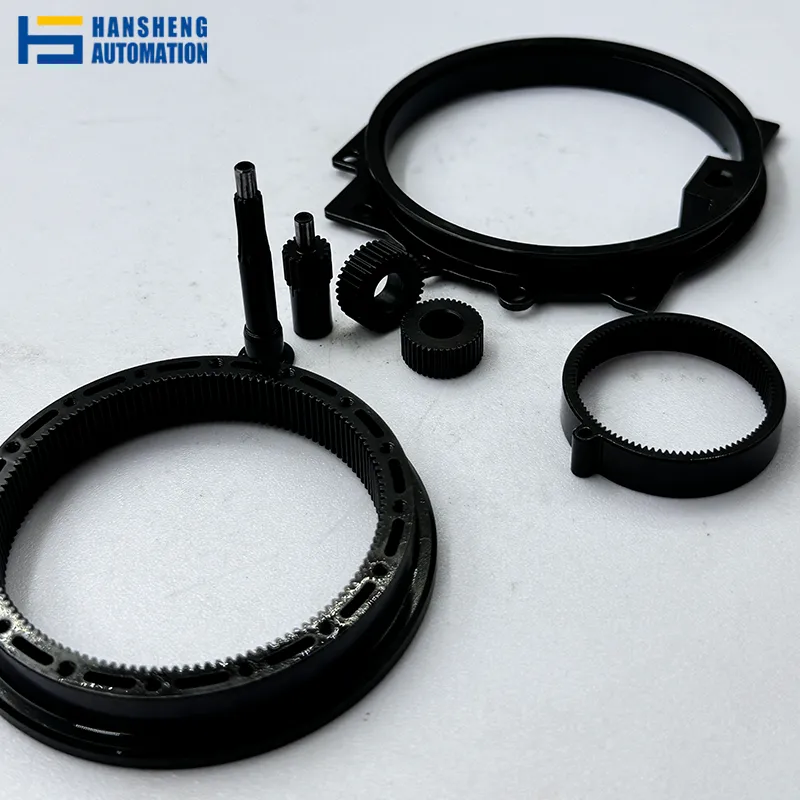
Internal Helical Gear
Brand: Hansheng
Accuracy grade: ISO/DIN/GB level 5
Gear module: 0.1–5.0
Tip diameter: 3 mm–300 mm
Introduction
What Is an Internal Helical Gear
An internal helical gear is a cylindrical gear with angled teeth machined on its inner bore surface. The helix angle, typically between 15° and 30°, achieves the same highly efficient, progressive tooth-meshing characteristics found in external helical gears. Helical gear engage progressively to smooth torque transmission, reduce noise levels, and distribute the load across multiple contact points simultaneously.
What sets internal helical gears apart from their external counterparts is the direction of tooth curvature and the resulting mesh geometry. When an external helical pinion meshes inside an internal helical gear, both components rotate in the same direction. This is a fundamental geometric difference from external gear pairs, where rotation directions are always opposite. This property is critical in planetary gear systems.
Product Specifications
| Parameter | Details |
| Tooth Form | Involute helical, internal (ring gear) |
| Helix Angle | 15° – 30° (custom angles available) |
| Pressure Angle | 20° standard |
| Module Range | Metric and imperial standards available |
| Accuracy Grade | ISO 6 – ISO 9 (application dependent) |
| Material Options | Case-hardened alloy steel, stainless steel, engineering plastics, through-hardened carbon steel, aluminum alloy, bronze / brass |
| Manufacturing Process | Internal gear shaping (slotting), broaching, grinding |
| Customization | Bore diameter, face width, helix hand, tooth count, housing integration |
| Quality Documentation | Material certificates, CMM inspection reports available on request |
Material Selection for Internal Helical Gears
Key selection factors include operating load and torque, running speed, environmental exposure, required service life, and whether weight or cost is a constraint. Here’s how the most commonly specified materials compare.
| Material | Strength | Wear Resistance | Corrosion Resistance | Weight | Cost | Best Application Fit |
| Case-Hardened Alloy Steel (e.g. 20CrMnTi, 8620) | Highest | Excellent | Requires coating | Heavy | Moderate | Heavy-duty planetary gearboxes, industrial drives |
| Through-Hardened Carbon Steel (e.g. 4140, 4340) | High | Good | Requires coating | Heavy | Lower | Medium-load gearboxes, general power transmission |
| Stainless Steel (304 / 316) | Moderate–High | Good | Excellent | Heavy | Higher | Food processing, pharmaceutical, marine environments |
| Aluminum Alloy (6061 / 7075) | Moderate | Moderate | Good | Lightest | Lower | Robotics, automation, lightweight precision drives |
| Engineering Plastics (Nylon, POM, PEEK) | Low–Moderate | Moderate | Excellent | Lightest | Lowest | Low-load instrumentation, quiet auxiliary drives |
| Bronze / Brass | Moderate | Good | Good | Moderate | Moderate | Low-speed, high-friction environments, worm-mating stages |
Key Advantages of Internal Helical Gears
- Compact co-axial design
Input and output shafts share the same axis, enabling significantly more compact gearbox packaging than equivalent external gear arrangements.
- Higher power density
The internal mesh geometry allows a larger contact area and longer tooth engagement, supporting higher torque transmission within the same envelope size.
- Smooth, quiet operation
Helical tooth geometry ensures progressive engagement, reducing impact noise and vibration even at elevated speeds and loads.
- Same-direction rotation
The co-rotating mesh is essential for planetary gear configurations.
- Reduced bearing loads
Internal gear mesh geometry generates lower separating forces compared to external pairs, reducing radial loads on supporting bearings.
Typical Applications
Internal helical gears provide compact, high-efficiency, co-axial power transmission in demanding applications.
Planetary gearboxes
The ring gear in planetary gear systems is almost always an internal gear. Helical tooth profiles add smoothness and load capacity to these high-performance reducers.
Automotive transmissions
Automatic and dual-clutch transmissions use internal helical gears extensively in their planetary gear sets for smooth, efficient ratio changes.
Industrial automation & robotics
Compact servo gearboxes and rotary actuators rely on internal helical gear stages for high torque density and precise motion control.
Wind turbine gearboxes
Multi-stage planetary gearboxes in wind energy applications use large-diameter internal helical ring gears to handle the extreme torque demands of rotor input stages.
Custom Internal Helical Gears
Standard catalog internal gears rarely match the exact bore diameter, face width, tooth count, or integration requirements of a custom drivetrain. Hansheng manufactures fully custom internal helical gears to your precise specifications — from prototype single pieces through to production volume supply.
Our engineering team supports you from initial design review through to final inspection, ensuring your internal helical gear optimizes for your specific load conditions, speed range, and housing constraints.
FAQ
What is the difference between an internal helical gear and an external helical gear?
An external helical gear has teeth on its outer surface. An internal helical gear has teeth cut on its inner bore. Unlike external pairs, when meshed together they rotate in the same direction.
What are internal helical gears most commonly used for?
Internal helical gears are primarily used in planetary gearboxes, automotive automatic transmissions, industrial servo gearboxes, and wind turbine drive stages.
How are internal helical gears manufactured?
Internal helical gears are produced using internal gear shaping with a reciprocating pinion-type cutter, or broaching for shorter face widths. Post-cutting, teeth may be ground for tighter accuracy grades.
Can Hansheng manufacture custom internal helical gears to my specifications?
Yes. Hansheng produces fully custom internal helical gears tailored to your exact requirements, including module, helix angle, tooth count, bore diameter, face width, material grade, and accuracy class. Share your application details and our engineering team will provide a design recommendation and competitive quote within 24 hours.