Chinese Gear Steel Grades Explained – S45C, 40Cr, 42CrMo, and 20CrMnTi Selection
Blog 2026-04-25
When sourcing from Chinese gear manufacturers, you may find that the gear materials differ from what you previously specified. For example, you might be accustomed to using 8620 carburizing steel, but the Chinese gear manufacturer quotes 20CrMnTi instead. Buyers unfamiliar with this will naturally wonder: Are these two materials the same?
Spur gear material selection becomes significantly more complex when sourcing from China — GB designations, heat treatment assumptions, and grade equivalencies all need to be verified before an RFQ is accepted.
This article covers the four most common steel grades used in Chinese gear manufacturing, their international equivalents, and how to choose between them based on module, load, and precision requirements.
Why gear material selection is harder than it looks
You don’t choose a material. You choose a material-and-heat-treatment combination.
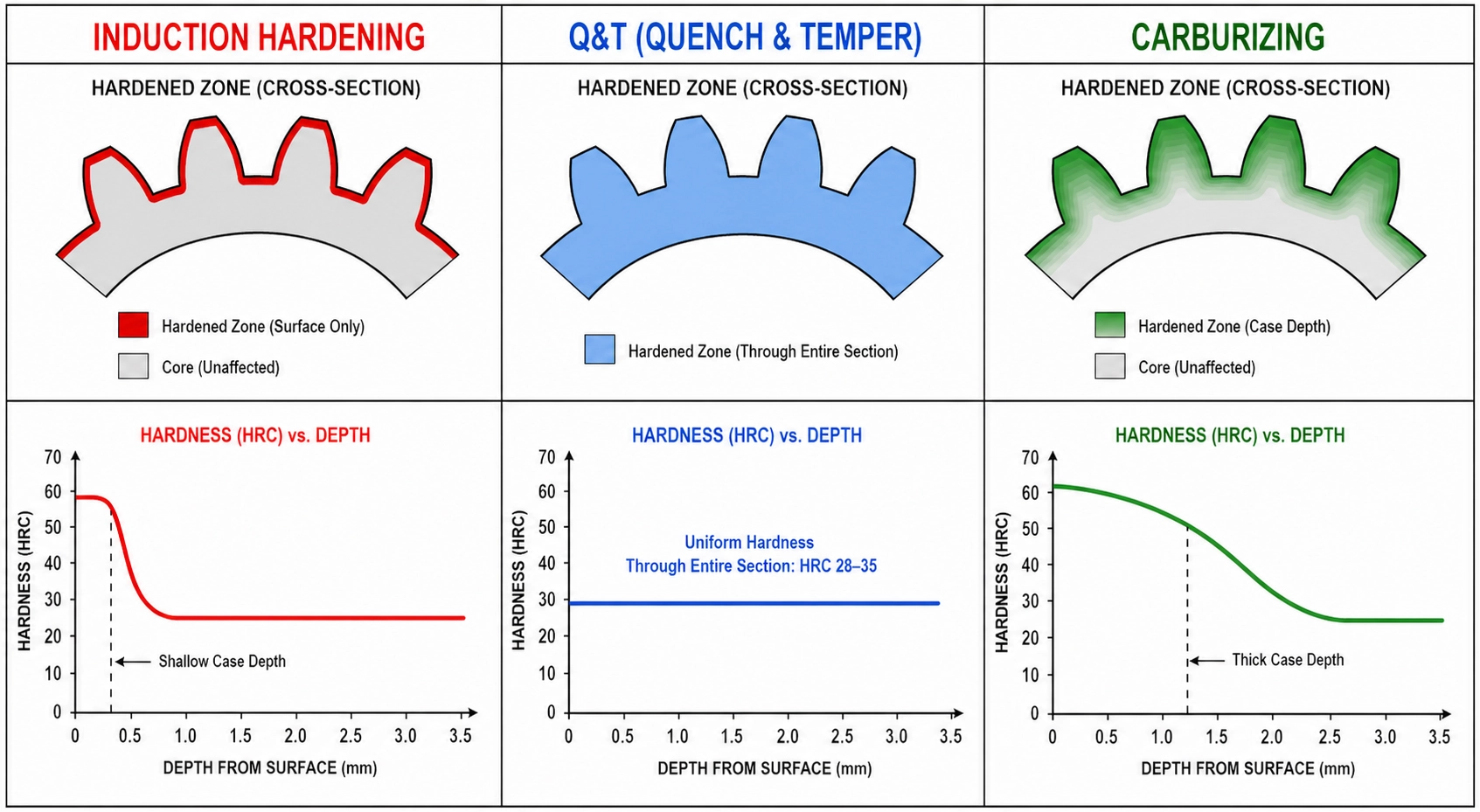
S45C with induction hardening is not the same gear as S45C with quench-and-temper. The surface hardness, case depth, fatigue life, and distortion behavior are all different.
1 Evaluating tensile strength, ignoring hardenability.
A material that achieves the target surface hardness on a small test coupon may show uneven core hardness across a wide-face, large-module gear blank. Hardenability — not peak strength — is the governing property for anything above M2.5.
2 Matching the grade but mismatching the process.
42CrMo is a quench-and-temper steel. Specifying it with a carburizing process wastes cost and adds distortion risk without meaningful performance gain. Every grade in this article has a preferred heat treatment.
3 Carrying prototype material into production.
S45C is a legitimate prototyping choice for moderate-load applications. It is not automatically the right material when the same geometry runs at higher torque in production. Upgrade decisions made at prototype stage are cheap; the same decision made after a production failure is not.
International grade cross-reference — read this before you send an RFQ to China
If you’ve been specifying steel by AISI or DIN designations, here’s the translation layer you need. Chinese mills and gear manufacturers work from GB (Guojia Biaozhun) designations. Although the vast majority of GB grades closely correspond to the grades you are familiar with, there are still some differences — ignoring these differences can easily lead to trouble for yourself.
| GB (China) | AISI / SAE | DIN / EN | JIS | Primary Heat Treatment | Match Quality |
|---|---|---|---|---|---|
| 45 (45#) | 1045 | C45 / CK45 | S45C |
Induction hardening HRC 50–58 (surface) Q&T HRC 28–35 (full section) |
Direct equivalent. Chemical composition closely matched. Safe to substitute without adjustment. |
| 42CrMo | 4140 | 42CrMo4 / 1.7225 | SCM440 |
Q&T HRC 28–35 (full section) Induction hardening HRC 50–58 (surface) |
Near-direct equivalent. Minor Mn range differences; mechanical performance is effectively identical. |
| 40Cr | 5140 | 41Cr4 / 1.7035 | SCr440 |
Q&T HRC 26–32 (full section) Induction hardening HRC 48–54 (surface) |
Near-direct equivalent. Performs between 45# and 42CrMo; a cost-effective middle tier. |
| 20CrMnTi | ~8620 | ~16MnCr5 | — |
Carburizing + Quenching
Case: HRC 58–63 Core: HRC 30–45 Typical Depth: 0.5–2.0 mm |
Functional equivalent. Not a direct compositional match, but standard for carburized gears in China. |
Why 20CrMnTi is marked “~” and not “=”
SAE 8620 contains nickel (0.40–0.70%), which improves core toughness after carburizing. 20CrMnTi replaces nickel with titanium, which refines the austenite grain structure and suppresses growth during the carburizing cycle — the practical result is lower distortion and more predictable case depth. 16MnCr5 (DIN) contains neither Ti nor Ni and relies on manganese and chromium alone for hardenability.
One more practical point
The heat treatment column matters as much as the grade name. A quote listing “42CrMo” with no heat treatment specified could mean anything from annealed bar stock (HB ≈ 200) to fully quenched-and-tempered (HRC 28–35). Always include the required hardness range or process name in your RFQ — it protects both sides.
Get a Free Material Recommendation →
Four materials, four manufacturing profiles
This section tells you what each material does — from the perspective of the people machining it, heat-treating it, and inspecting it to ISO Level 5.
S45C (1045 / C45)
S45C is the most machinable steel in this group. Gear hobbing and skiving cycle times are shortest, tooling consumption is lowest, and the material behaves predictably across the full module range we work with (M0.1 to M5.0).
Heat treatment
Induction hardening is the preferred process, delivering surface hardness of HRC 50–58 with minimal full-section distortion. Quench-and-temper is a legitimate alternative for applications requiring uniform through-hardness (HRC 28–35). S45C should not be carburized: with 0.42–0.48% carbon already in the base material, the carburizing cycle adds cost and processing time without the case-depth control or surface hardness improvement that a low-carbon carburizing steel delivers.
Precision retention
Induction hardening produces manageable distortion on small-to-medium cross-sections. At ISO Level 5, post-heat-treatment corrective skiving on the KPS30 — or grinding on a dedicated gear grinding machine — is sufficient to recover tooth profile and lead accuracy for most M0.5–M3 applications.
Note
S45C has a Jominy end-quench hardened depth of roughly 10–15 mm. On gears with face widths above 40 mm or modules above M3, core hardness becomes uneven — the surface meets specification while the subsurface does not. If your application falls into that range, the next material in this list is the appropriate choice, not a harder heat treatment cycle on S45C.
42CrMo (4140 / 42CrMo4)
Machinability
Good in the quenched-and-tempered condition (HB 220–250). Cutting parameters are stable and predictable; while the tooling cost is a bit higher than for S45C, it remains very reasonable.
Heat treatment fit
Quench-and-temper is the core process for 42CrMo — it delivers full-section hardness of HRC 28–35 with consistent toughness throughout the gear blank. Induction hardening can be applied as a secondary surface treatment to bring tooth-face hardness to HRC 50–58 where wear resistance is the primary concern. What 42CrMo is not suited for: carburizing. The carbon content is too high for the process to produce a meaningful case-to-core hardness gradient, and the additional heat cycle introduces distortion without the surface hardness return you’d get from a proper carburizing steel.
Precision retention
This is where 42CrMo separates itself from S45C for medium-to-large cross-sections. Quench-and-temper distortion is significantly lower than carburizing, and the uniformity of the hardness profile across large face widths means post-heat-treatment corrective operations are predictable. In our production experience, 42CrMo Q&T gears consistently show the highest first-pass acceptance rate on CMM inspection at ISO Level 5 — the distortion is within a range that skiving can correct without requiring rework iterations.
Module range
M1 to M5 across the full face-width range. For those gear application scenarios where S45C fails to meet performance requirements due to its insufficient hardenability, 42CrMo is a suitable alternative.
20CrMnTi (~8620 / ~16MnCr5)
Machinability
Good in the annealed condition, which is how gear blanks are typically received and pre-machined. After carburizing and other processes, its machinability is greatly reduced.
Heat treatment fit
20CrMnTi is very suitable for the carburizing and quenching. The titanium addition stabilizes the austenite grain during the high-temperature carburizing cycle, suppressing grain growth that would otherwise increase distortion and reduce toughness. The treated gear achieves a surface hardness of HRC 58–63, a core hardness of HRC 30–45, and good toughness. Typical effective case depth runs 0.5–2.0 mm depending on module and application.
Precision retention
Thanks to titanium grain refinement, 20CrMnTi distorts less than most carburizing steels (e.g., SAE 8620). This allows post-carburizing corrective skiving on the KPS30 to reliably achieve ISO Level 5 tooth profile accuracy without grinding. For applications needing HRC 58–63 case hardness and ISO Level 5 precision, 20CrMnTi delivers both in the same production flow.
Module range
M0.5–M3 is the optimal range. At small modules (M0.5–M1), case depth must be tightly controlled to avoid over-carburizing at the tooth tip — the case-to-tooth-thickness ratio becomes critical below M1.
40Cr (5140 / 41Cr4)
40Cr is positioned between S45C and 42CrMo in both performance and cost, and despite being relatively obscure in Western specs, it is more often the right choice than you might think.
Machinability
Comparable to 42CrMo in the quenched-and-tempered condition. No meaningful difference in practice.
Heat treatment fit
Quench-and-temper to HB 220–260 for full-section hardness. Induction hardening brings tooth-face hardness to HRC 48–54 — slightly below 42CrMo’s ceiling, but sufficient for a wide range of medium-load industrial applications. Not a carburizing candidate for the same reasons as 42CrMo.
Where it belongs
Industrial automation drive trains at moderate torque and speed are the most common scenario. If your current S45C gear is failing, 40Cr is worth evaluating before going straight to 42CrMo — the material cost difference is meaningful at volume, and the performance step up is real.
Module — the hidden constraint that narrows your material options first
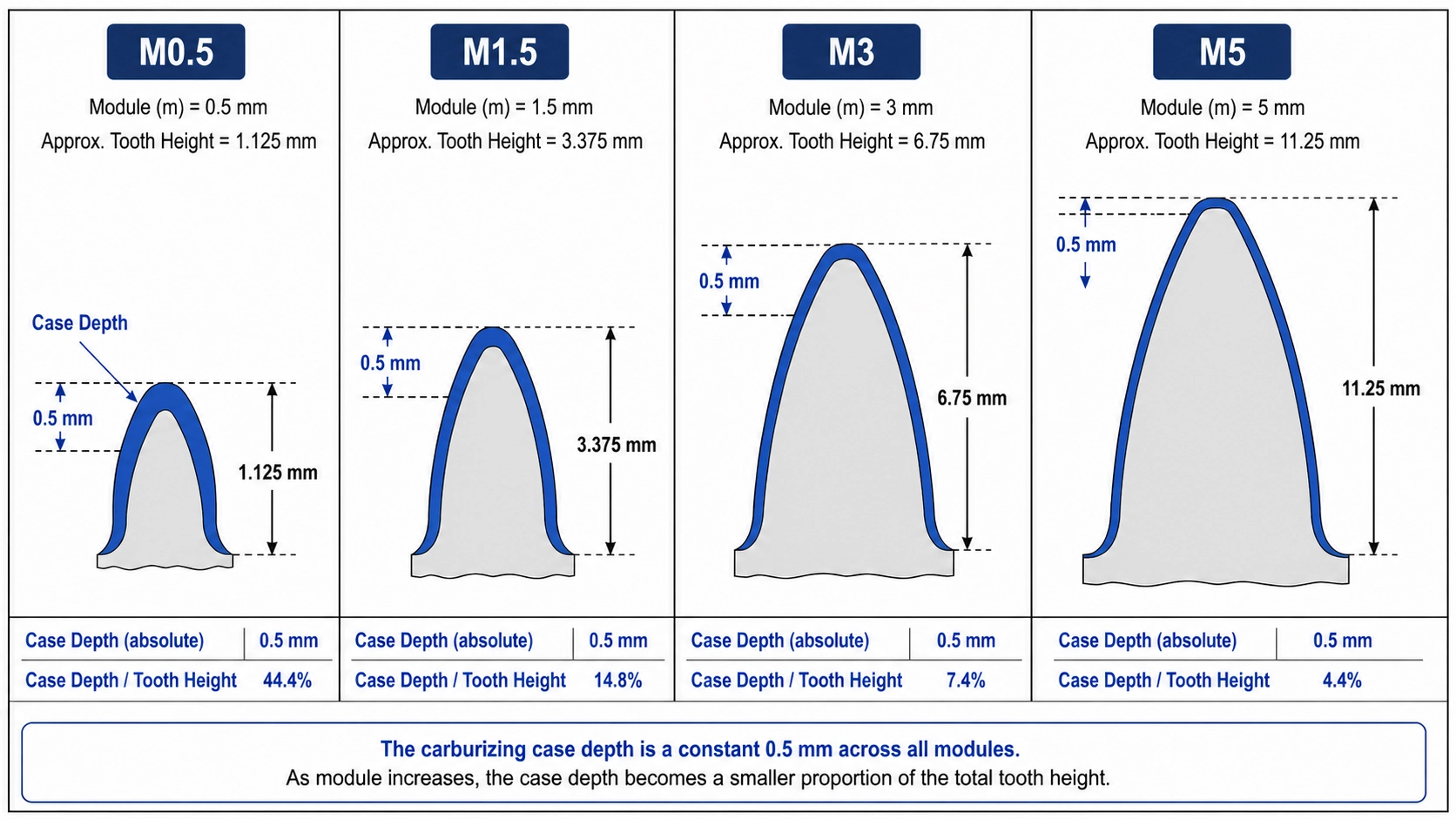
After discussing the four categories of materials in the previous section, we can see that the module also affects material selection, because different modules correspond to different heat treatment requirements.
The smaller the module, the thinner the tooth, and the more sensitive that tooth is to case depth, distortion, and thermal gradient during heat treatment. The larger the module, the deeper the cross-section, and the more hardenability — not surface hardness — becomes the governing property.
Small module: M0.1–M1.5
Within this module range, the tooth geometry is the primary limiting factor. A 0.8 mm module gear tooth has a full tooth height of roughly 1.8 mm. A standard carburizing cycle producing a 0.5 mm case depth is already consuming 28% of the tooth height.
The appropriate processes here are either carbonitriding (case depth 0.1–0.4 mm, very low distortion) on S45C, or shallow controlled carburizing on 20CrMnTi with strict case depth specification on the drawing.
Medium module: M2–M3
S45C with induction hardening, 42CrMo with Q&T, and 20CrMnTi with carburizing are all viable. Material choice in this range is driven primarily by load profile and precision requirement rather than process feasibility.
Large module: M3.5–M5
Face width >40 mm — S45C’s hardenability limit becomes critical. The tooth cross-section is too large for induction hardening alone. 40Cr is the minimum sensible grade; for meaningful torque, 42CrMo Q&T is recommended. 20CrMnTi carburizing is feasible but longer furnace cycles and higher distortion risk make it less cost-effective than Q&T.
Note
The larger the module, the more hardenability matters, and the more alloying elements you need to achieve it. S45C’s hardenability ceiling corresponds roughly to M2.5 at moderate load. Above that, the material needs to change — a longer or hotter heat treatment cycle on S45C will not close the gap.
Material selection matrix — a decision tool you can use on the next RFQ
Before using this table, establish three inputs in order:
- (1) operating speed in RPM
- (2) load type — steady, variable, or shock
- (3) the precision class required.
If your application spans more than one load category, select by the most demanding condition, not the average.
| Operating Condition | Module Range | Recommended Material | Heat Treatment | Achievable Precision |
|---|---|---|---|---|
| Light load, low speed (< 500 RPM), prototype or low-cycle | M0.5–M3 | S45C (45#) | Induction hardening | ISO Level 5–6 |
| Light load, low speed (< 500 RPM), prototype or low-cycle | M0.1–M1.5 | S45C (45#) | Carbonitriding | ISO Level 5–6 |
| Medium load, continuous duty (500–1,500 RPM) | M1–M5 | 42CrMo | Q&T | ISO Level 5 |
| Medium load, budget-constrained, moderate torque | M1–M3 | 40Cr | Q&T or induction hardening | ISO Level 5–6 |
| Heavy load, high cycle, high contact stress | M0.5–M3 | 20CrMnTi | Carburizing + quenching | ISO Level 5 |
| Heavy load, high cycle, large cross-section | M3.5–M5 | 42CrMo | Q&T + induction hardening | ISO Level 5 |
| Shock load or frequent load reversal, any speed | M1–M5 | 42CrMo / 20CrMnTi | Q&T / Carburizing + Q | ISO Level 5 |
Three notes on using this recommendation
First, “achievable precision” assumes post-heat-treatment corrective operations are included in the process plan where necessary. A carburized 20CrMnTi gear does not come off the quench at ISO Level 5 — it gets there through either a grinding pass or a controlled skiving pass after heat treatment.
Second, the recommend does not replace a load calculation. It is a starting point that filters out obviously inappropriate choices before detailed stress analysis begins. If your calculated contact stress or bending stress pushes against the limits of the recommended grade, treat that as the signal to move up one tier.
Third, if your application sits at the intersection of high speed, shock loading, and a precision requirement of ISO Level 5 or better, neither S45C nor 40Cr belongs in the conversation. Start at 42CrMo or 20CrMnTi and select between them based on whether through-hardness or case hardness better fits the failure mode you’re designing against.
Cost structure — what actually drives price and lead time
The data in this table is based on our own experience and may differ from that of other manufacturers. Please exercise your own judgment when using it.
| Material | Relative Cost | Heat Treatment | Additional Lead Time |
|---|---|---|---|
| S45C (45#) | Baseline (1.0×) | Induction hardening | Baseline |
| 40Cr | ~1.15–1.25× | Q&T or Induction hardening | +1–2 days |
| 42CrMo | ~1.3–1.5× | Q&T | +2–3 days |
| 20CrMnTi | ~1.3–1.5× | Carburizing + quenching | +5–7 days |
The material cost differences in this table are real, but they are rarely the dominant factor in a gear quote. The more significant variable is heat treatment lead time.
Induction hardening is a fast, localized process: a gear blank goes in and comes out the same day. Quench-and-temper (Q&T) adds one to three days depending on batch scheduling and section thickness. Carburizing, on the other hand, is a furnace process that runs at high temperatures over an extended cycle; including post-carburizing quench and temper, the total turnaround time for a 20CrMnTi gear typically adds five to seven days over an equivalent induction-hardened part.
If your project schedule cannot absorb a carburizing cycle, combining 42CrMo Q&T with induction hardening delivers the next-best performance profile with a lead time you can easily plan around. Specify the process, not just the material, when lead time is a constraint.
FAQ
For gear applications, yes. The two grades share the same carbon and chromium content; the only difference is a slightly wider manganese range in the GB specification. After quench-and-temper, mechanical properties are indistinguishable in practice.
Functionally, yes. Both are low-carbon carburizing steels that deliver a hard case over a tough core. The key difference: 8620 uses nickel for core toughness; 20CrMnTi uses titanium for grain refinement, which typically produces lower post-quench distortion and more predictable case depth.
Specify carburizing when you need maximum tooth-face hardness (HRC 58–63) and high-cycle fatigue resistance on compact gears (M0.5–M3) — and when your schedule can absorb a five-to-seven day furnace cycle. Specify induction hardening when you need a fast, localized surface treatment on S45C or 42CrMo, or when the module exceeds M3 and distortion risk makes carburizing impractical.
Depends on the property. 20CrMnTi after carburizing achieves HRC 58–63 at the tooth face — well above 42CrMo’s Q&T ceiling of HRC 28–35 — making it the stronger choice for wear resistance and surface fatigue life.
Upgrade when any of the following apply: module exceeds M2.5, face width exceeds 40 mm, or the application runs continuously at medium-to-high torque. At these conditions, S45C’s hardenability ceiling means subsurface hardness will fall short even if the surface meets specification — a harder heat treatment cycle will not fix this.